Showing posts with label Scottish War Memorials Project. Show all posts

Friday, 22 July 2016

Private war memorials in churches

Just south of Dunnotar Castle in the old county of Kincardine is the small village of Catterline. There is no civic war memorial in the village but there are memorials in the Church of Scotland and Episcopal Church to the men of the village who lost their lives in the World Wars. The cross in the churchyard of St James’ Episcopal Church lists eight First World War names and one for the Second World War. Like many church memorials is lists only names and gives no other details such as rank, unit or date of death to help anyone researching the names. There are also two men with the same name - William Stephen - which is always a challenge when there are no other details. 

Church War Memorial, St James' Catterline
Luckily, inside the church is a private memorial to one of the William Stephens with more information to help identify who he was. 

Private Memorial in St James', Catterline
Unlike civic memorials or other public memorials, privately purchased memorials often have a lot of information on them. They can be simple memorials such as an inscription on a headstone of they could be a brass or marble plaque on a church wall; or sometimes they are stained glass windows or other church fittings. Private memorials often give details of the cause and place of death and family information. Sometimes they will give the citations for gallantry awards or their war service before their deaths. A private memorial such as the one to William Stephen should be a very useful source of information for researchers then.  

The one in Catterline Church certainly has plenty of information. It records William Stephen’s rank, ship, next of kin, date of death and age. It was erected by the officers and engineers of the Australian Transport ship A.49 – a ship used to ferry Australian service personnel and cargo. Engineer Stephen had been in the crew of the SS “Seang Choon” before it had been requisitioned in 1915 as the HMAT 49 and had remained on the ship – still in the Mercantile Marine – when it was under Australian orders.

Engineer Stephen died in early 1917 but a search on the fate of the ship shows it was not lost in early January but in mid-1917. The HMAT 49 was torpedoed by U-87 off Ireland in June 1917. There is also no record of the ship being in any action which would have caused the death of Engineer Stephen.

Stephen’s private memorial records that he died on “Active Service” on  2nd January 1917 but a search on the Commonwealth War Graves Commission database does not show an entry for him, neither does the Scottish National War Memorial database. The CWGC and SNWM have strict criteria for inclusion for men of the Mercantile Marine on their databases. Engineer Stephen may have faced many of the same risks as his Royal Navy colleagues on the high seas but if he did not die as a result of enemy action then he would not qualify for inclusion on the CWGC or SNWM databases. The inscription “Active Service” is a red herring. This is unfortunately quite common on private headstones where ranks, units and dates can all be inscribed incorrectly and send researchers down blind alleys.

As it turns out 2nd Engineer William Stephen did not die on active service. At the time of his death he was not even at sea, he was in Greenwich Hospital and died of Meningitis & Hypostatic Pneumonia. If he had been in the Royal Navy rather than a civilian organisation he would have qualified for commemoration. He is one of many Scottish mariners who did their bit in the war but are not remembered in official records as a war death. However he is still remembered in his home village, and by the Scottish Military Research Group Commemorations Project (SMRGCP)

Sunday, 14 October 2012

Registering for the forums

One of the most common emails we receive is from people who have newly registered for either the War Graves Project or the Memorials Project and haven't received their confirmation of account activation.

The way the forums are set up, we have to manually activate every new member. By doing this we avoid having any malicious members posting spam or offensive links. We usually get a large number of new members who are nothing more than spam, and while their links appear in the user profiles, by manually activating every member it means that their rubbish is not allowed to infect the main part of the forum.#

However, what this means is that the automated process does not complete, and so the email confirming that a new members profile has been activated is not sent out.

We usually check the list of members every couple of days, and activate any genuine new members and delete spammers at that time.

So...if you're a new member, and you're still waiting for your email confirming your account is active, we would suggest trying the following:

1. visit the forum and try to log in. You may find your account is already active.

2. If it isn't wait another day or so. We try to check every day or so, but occasionally we aren't able to.

3. If you're still waiting after a week or more, then please email us at scottishwarmemorials@hotmail.co.uk - let us know when you joined, and what your username is. We'll look into it and get back to you ASAP.

What we find is that sometimes people reply to the initial welcome email they get. We'd suggest you DON'T do that - that has your account details INCLUDING YOUR PASSWORD. While we have no intention of giving out your password for any reason, we usually have no access to these and have no need to know it. If you MUST reply using the initial email, please check the text and REMOVE your password.

One other thing - registering to use the forum is not the same as joining the Research Group. If you want to join the Research Group (and have access to any research material, and to find out first about any new projects we might have) then you can join us by visiting this page and clicking the email link and filling in your details. We'd love to have you on board!


Monday, 6 February 2012

All that's shiny on a war memorial isn't bronze...


A recent report in the Linlithgow Gazette has highlighted another shocking case of metal theft. Or has it?


The newspaper photograph shows that something is clearly missing at the top of the Blackness War Memorial. A closer inspection of the Blackness thread on the Scottish War Memorial Project shows that in 2008 what was there was a slab of dark grey granite and not a bronze plaque.


More information on the SWMP tells us that what was there before the slab. 'The Scotsman' of Wednesday 27th December 1922 reported on the memorial's unveiling:


BLACKNESS.—The memorial to the men of Blackness district takes the form of a clock tower, built of Rubislaw granite...The cost of the memorial was £200, which was raised by voluntary effort.


So no bronze plaque then. The fact that no-one knew that the hole at the top of the memorial used to be a clock suggest that it was replaced quite some time ago. What a shame that Blackness couldn't maintain an integral part of its memorial. The reasons for the clock's removal may now be lost in the mists of time but hopefully when the unsightly gap is filled on the Blackness memorial they can find something more suitable than a plain grey slab? Perhaps this is a perfect opportunity for something decorative to be added? Perhaps that is already happening and no-one told the local councillor?

Blackness has lost its clock but there is another Scottish village which still has a war memorial clock tower and is in very serious danger of losing it. The Parish of Clyne War Memorial in Brora, Sutherland has chimed for nearly ninety years but age has taken its toll. The clock mechanism and the tower it sits in, are both in urgent need of renovation. The local authority does not have the funds to repair it so locals are looking into setting up a Friends of Clyne War Memorial group to help find the funds to save their memorial. You can visit their Facebook page here to lend your support.

Perhaps this recent case at Blackness highlights the need for a proper database on Scottish war memorials which could easily have shown that no bronze was stolen. There is the Scottish War Memorials Project but it is an unfunded and voluntarily run database. Should that data be taken on by a national body? (And by national I mean Scotland not UK). The UK National Inventory of War Memorials listing of Blackness does not mention any metal and there are no photographs so it really wouldn't have been much use here. Do we need a SIWM based on SWMP data with locations and photographs there for the taking...

As always we'd welcome your comments on anything discussed above.

Wednesday, 23 November 2011

Credit where credit is due


For nearly five years now the volunteers of the Scottish War Memorials Project have been going out in their spare time photographing and recording memorials all over the country. No-one asks for money for recording them and no-one has to pay to view them.  It all works very well.

Sometimes though someone takes a liberty. When you see your photographs, in fact when you see a lot of your photographs on another website and uncredited it makes your blood boil.

I’m not going to give publicity to the plagiarist who took dozens of images off our forum, mostly the hard work of one man, but what I can’t understand is why the owner of the new website thought it was OK to pass all the photographs off as his own work?

The owner of the site has been contacted and has updated one page. Hopefully he’ll make more of an effort soon and give proper credit where it is due and stop passing it all off as his own work. 

Then he may get a plug on this Blog!

Saturday, 19 November 2011

Lost & Missing war memorials

Recent posts on the Scottish War Memorials Project have been heartening about the fate of missing war memorials and rolls of honour. Some have definitely been destroyed when a building has been demolished, and some have been thrown away in refurbishment, but as we add to the entries of memorials recorded by the project we are finding more memorials in storage and in private hands.

While some people place no value on them, it's obvious others do. People will happily hold memorials and rolls of honour for now defunct companies, churches and clubs in trust. Sometimes a new home can be found in a local museum but sometimes that is not possible and people just take them home rather than see them sit in a skip.

Even ones which we know have gone forever have sometimes been photographed. Both the St James's church and North Merchiston church in Edinburgh have been demolished but photographs of their war memorials are held by Greenside Church and St Michael's Church.

Killiecrankie School's Roll of Honour may have disappeared, and may never re-appear, but the names it listed were recorded in the local paper at the time and are still known to us today.

And hopefully in the absence of the original memorial a transcription will do.

In 1964 When St George's Church in Charlotte Square merged with St Andrew's on George Street in Edinburgh, St Andrew's was to be the home of the new congregation. The St George's war memorial was built into the fabric of the building so instead of moving it the names were inscribed onto a brass plaque and hung in the renamed St Andrew's and St George's. At St George's in Glasgow City Centre the names are listed on a contemporary glass plate. The original memorial has gone into storage but the most important thing on it, the names, are at least still on public display.

So while Killiecrankie may never get back its original Roll perhaps they can still create a new one with the names of those who never returned, and fulfil the hope of the people of Killiecrankie of 1922 that the names would not be forgotten.

p.s. Another Killiecrankie Roll survives from 1915 which lists those from Blair Atholl and Killiecrankie serving in the Forces.

Friday, 11 November 2011

Missing Dumfries War Memorial

Thanks to Paul Goodwin for another Blog article today. Paul found references to a memorial unveiling in Dumfries in 1922 but has not been able to trace the memorial, or even its original location. I'll copy Paul's words from the Scottish War Memorial Project.

Dumfries and Maxwelltown Painters

Location: Original location not confirmed but believed to be in the main bar of the Globe Inn, 56 High Street, Dumfries at OS Map Ref NX 972 759. Its current location is unknown.

The unveiling of this memorial was reported in the Dumfries and Galloway Standard and Advertiser of 26th April 1922 and in another local paper of the same date. In one paper it is reported that the memorial is in the Hall of the Globe Inn and in the other that it is in the Globe Hotel Hall. Over a hundred men from Dumfries and Maxwelltown Painters Trade had served in the war so we can suppose that the number of men at the unveiling would have been close to, or even exceeded 100. There are currently two Globe Inns in Dumfries, one is a small bar in Maxwelltown which has never had a hall and is large enough for only 20 – 30 people with no sign of any memorial so we can discount that. Local trades directories, enquiries at the Ewart Library and the local Family History Society show no other Globe Hotels or Inns at the period so that leaves only the one on the High Street.

The Globe Inn (High Street) has never had a separate hall, nor is there any sign of the memorial there currently. The Inn has been in the ownership of the same family since the 1930s and they have no knowledge of the memorial, nor have any major changes or alterations been made in their ownership, it is a very historical building. It is difficult to understand that the memorial might have been removed within just 10 or so years of its unveiling. All of the rooms are quite small and could not relate to the hall described except for one large (long) room which is now used as the main bar.

The newspaper reports the position as occupying a prominent position in the centre of the end wall of the room, facing the door. If this refers to the main bar then this is exactly where the doors are to the Ladies and Gentlemens Toilets. So that is the probable location, but what happened to it and when?

Transcription from Dumfries and Galloway Standard and Advertiser dated 26 April 1922.

Dumfries Painters Memorial

Roll of Honour Unveiled

An interesting gathering was held in the Globe Hotel Hall, Dumfries on Saturday evening, when a memorial to members of the painters’ craft belonging to Dumfries and Maxwelltown, who fell in the great war was unveiled with appropriate ceremony. The memorial, a symbolical figure of “painting” occupies a prominent position in the centre of the end wall of the room, facing the door. It is the work of Mr George Graham, one of the veteran members of the craft in the town, and of his son, Mr Claude Graham, who, unfortunately, was taken ill and died while the work was in progress. The painting has a representation of a female figure holding a palette in her right hand, while with the left she points to the inscription which occupies the centre of the upper part of the picture. The inscription is as follows: “In commemoration of those belonging to the painting trade in Dumfries and Maxwelltown who made the supreme sacrifice during the great war.” At the bottom left hand corner there is a shiedl with the painters’ arms and the motto, “Amor et Obedientia.” An ornamental border with the rose, thistle and shamrock intertwined encloses the symbols, and the list of
NAMES OF THE FALLEN
which are as follows: Second-Lieutenant J. M. Haining,, K.O.S.B.; Sergeant J. Hewitson, A. and S.H.; Corporal R. Constantine, H.L.I.; Lance-Corporal A. McGeorge, K.O.S.B.; Private A. McKenzie, K.O.S.B.; Private J. Bryden, K.O.S.B.; Private Albert Law, K.O.S.B.; Private J Coyle, K.O.S.B.; Private D. Bouskill, K.O.S.B.; Private R. Brown, K.O.S.B.; Sergeant William Brown, R.G.A.; Private William Neisham, R.E.; Private J. Nelson, S.R.; Private A. Jamieson, B.W.; Private J. McAdam, Con. R.; Private J. Graham, H.L.I.; Private Alexander McAdam, R.E.; Private R. Simm, R.S.; Gunner J. Bell, R.G.A.; Private Alexander Harrison, K.O.S.B.; Private Robert Jackson, K.O.S.B.

The memorial is enclosed in a massive oak frame, this part of the work having been executed by the late Mr D. Constantine.

(transcription ends)

In the article, there follows a description of the ceremony which mentions a welcome home ceremony for members of the craft which had been held in the same hall two years previously. Also mentioned that over 100 members of the trade had gone to fight and 21 had “made the supreme sacrifice”. The memorial was unveiled by the president, Mr Wilson who accepted it into their safe custody.

Friday, 26 August 2011

When is a Group not a Group?

...When it is a society.

Recent issues with the availability of the war memorials and war graves forums on a 24 x 7 basis, plus the realisation that we are not as well known as we thought, have convinced a few of us that we finally have to take the bull by the horns and form a committee to run things. We've always taken a bit of pride in our independence and the fact everything is done by volunteers and on free hosting sites. However we have reached a stage where we need to take a more mature view on how we operate.

For one thing the data we have on the forums need to be stored on a secure database. The only way we can see that happening is by getting some sort of funding, and a large amount of it at that. To get funding we need to be a charity, and to be a charity we need a society with a properly elected and constitutionally bound committee. We also need to raise our profile too. Being a proper society should help with that.

Since we have come to that decision we feel there is no point hanging around so a meeting a.s.a.p. to kick things off would be a good thing.

We have decided to meet at 2pm at the Camperdown Bar in Queen Street Station in Glasgow, on Saturday 3rd September. We felt that was a good central location in Glasgow and should be easy to get to from a lot of places.

We'd like to invite anyone interested along to the meeting, hopefully the first meeting of a new society interested in all aspects of Scottish military history.

If you'd like to come along please let us know by contacting us on the SMRG website feedback page. Let us know your e-mail address and mobile phone number. That way we can make sure that everyone knows if there is a sudden last minute change of plan.

For those not able to attend we would still like you to be involved so please feel free to contact us with thoughts on the future of any society formed; plus any items you'd like discussed so I can add them to an agenda I am preparing for the day.

The meeting place of a bar has been chosen so that once the formalities of the day have been finished with we can have an infomal get together. It's a Wetherspoons pub so they are quite happy to serve tea and coffee during the day too for those driving. I'm hoping the actual meeting will take about 60-90 mins and then we have the rest of the afternoon to chat.

Monday, 25 July 2011

Technical problems

We've been having some problems with the War Memorials Project and the War Graves Project today. For a while both forums were offline.

It seems the War Graves Project is back up and running, but we still have problems with the War Memorials Project. While it looks like it's back to normal, we can't seem to make any posts to it.

Hopefully this is only a temporary setback and we should be back to business as usual in due course.

This is one of the drawbacks of having our site hosted externally - any problems like that are outwith our control. One of our hopes for the future is that we can host the site ourselves and not be dependant on others - but this is something for the future.

In the meantime, keep checking our feed on Twitter or our Facebook page for updates. We'll also post an update here once we have more news.

Finding the Fallen of Inverkeithing

While browsing the Great War Forum, I came across the following topic, where Alex Morris is attempting to research the fallen of Inverkeithing.

He has a number of names he has so far been unable to identify, so I thought it would be helpful to post them here in the hope that someone could assist.

Infromation can be submitted to the thread on the Great War Forum (registration is free) or you can contact us through the comments here or by emailing scottishwarmemorials@hotmail.co.uk and we'll be happy to pass the information on.

Here's the list of "missing" names:

ANDERSON JAMES A.
BINNING JAMES
BORTHWICK JAMES F.
BORTHWICK GEORGE
BROWN DAVID
BRYANT ARTHUR E.
BURNETT CHARLES
CHARLTON JOHN
CRAWFORD COOPER
DONALDSON WILLIAM
GRANT DONALD
HORNE CECIL
KAY WILLIAM H.
LAWRIE JAMES M.
MACNAMARA DAVID
MCGOVERN JAMES
PETRIE JOHN
PRYDE WILLIAM
SMITH FRANCIS
THORNTON ROBERT
THORNTON WILLIAM

Saturday, 14 May 2011

Uproar over Kelso War Memorial Flowers

The Southern Reporter today reports of a bit of a kerfuffle in Kelso after the local parks maintenance manager ordered the filling in of flower beds around Kelso War Memorial, without the local councillors knowing about it.

Although none of the photographs on the Scottish War Memorials Project show the flowerbeds around Kelso in full bloom it does show you how prominent they are.

Wednesday, 4 May 2011

Update on Scottish War Graves and Scottish War Memorials

It isn't often that we highlight the work done by the volunteers of the Scottish War Graves Project but I've done a quick tally of the number of Scottish military headstones they have recorded and there are now well over 18,000 photographed. In fact it is a lot closer to 19,000.

Many of the stones are the Commonwealth War Graves in Scotland but just as many, if not more, are private gravestones which record loved ones lost overseas during the colonial wars of the nineteenth century and the two World Wars. It is only since the Falklands War that British war dead have been repatriated, and for the wars before then the graves were marked or unmarked in a foreign field. That meant a lot of families inscribed the details on a headstone in a local cemetery.

It's worth pointing it that unlike some other sites which record war graves the SWGP doesn't charge a fee for a photograph. They are all collected by volunteers and made available online for free.

The sister project recording Scottish War Memorials is doing well too. Here are some figures of the numbers of memorials recorded to date:

* 1400 Civic war memorials (very nearly all of Scotland's civic memorials recorded)
* 850 Church war memorials
* 700 War Memorials to individuals
* 240 Regimental and unit war memorials
* 140 School war memorials
* 525 Other Scottish war memorials

That gives a total of 3855 Scottish war memorials recorded online and available to view for free.

Friday, 22 April 2011

James Stewart of Blairgowrie

This New Zealand blog mentions the help of members of the Scottish War Memorials Project in locating an extended family member who died in the Second World War. It's always a pleasure to help someone with their research. Although we can't in most cases do your research for you, we can provide pointers to useful sources of information - it's what we're all about.

I thought it worthwhile to highlight the blog post as it's an interesting story.

Lost without trace – Sentimental Sunday 

I had no idea who this dashing young airman was until Auntie told me “that’s your Granny’s brother, James. He was in the Air Force and went missing in World War II around the time Great Grandpa Stewart died”. 

I didn’t know that Granny had a third brother, and I wanted to find out more about James so I did a bit of digging. Great Grandpa (James Cameron Stewart) died on 5 February 1941, so James must have been reported missing around then. If I hadn’t asked about this photo, he could have been lost without trace a second time :-( 

I searched the casualties on the Commonwealth War Graves Commission website and found: “in Memory of Sergeant JAMES STEWART 945565, 149 Sqdn., Royal Air Force Volunteer Reserve who died on 21 February 1941. Remembered with honour. Runnymede Memorial” along with a photo of the memorial. 

I then posted an appeal for help at the Scottish War Memorials Project and a very helpful member was able to tell me that there is mention of a James Stewart, Sgt Royal Air Force, on Blairgowrie War Memorial. He also gave me the following information: “Shows as born Blairgowrie, seved in Bomber Command. Airborne at 18.25 from Mildenhall that night in Welllington R-1045 on operation to Wilhelmshaven. Aircraft lost without trace, all crew commemorated at Runnymede.” The Scottish War Memorials Project have photos and information on many of the war memorials in Scotland, posted by volunteers, many of whom are extremely knowledgeable and enthusiastic. 

While googling for a photo of a Wellington R-1045, I came across the Aircrew Remembrance Society which mentions the Wilhelmshaven Raid: “Took off from R.a.F. Feltwell, Norfolk at around 19.00 hrs to take part on a raid on Wilhelmshaven. a total of 54 Wellingtons took part with 19 actually bombing the target area. No details were available of damage to the town. This was one of two aircraft lost on this raid – the other a Wellington IC R1045 OJM from 149 squadron flown by F/O. Ian Henderson was also lost without trace, together with all six crew. Another Wellington IC T2547 crashed on landing, colliding with a fence near the airfield perimeter – all this crew survived.” 

My great uncle James was presumably part of the crew on F/O Henderson’s plane. I will contact the Aircrew Remembrance Society to see if they have any further information, or if they would like a copy of James’s photo. They are doing a great job of helping relatives of fallen and missing airmen from the 1939-45 air war and preserving memories, documents and photographs – their website is well worth a visit. So, this week I will check for a birth record for James in Blairgowrie, Perthshire, which should confirm his parents as James Cameron Stewart and Janet Christian (Chris) Hardie. Then I’ll see what else I can find out about James’s short life – he would have been around 26 or 27 when he died. I can’t imagine what Chris went through, losing her husband and a son in less than 3 weeks.

Tuesday, 29 March 2011

Meet David McNay - The SMRG Team

Another one of those articles where we have to talk about ourselves. This time, it's my turn...
Any excuse to post this photo again...
I have always had an interest in military history of some description: from an early age I remember playing at soldiers with my brother – we had a huge bag of plastic toy soldiers and would arrange battles with them in endless row where they were gunned down in increasing number until there were perhaps only one or two left among a huge pile of the “dead”. Like other children, we would build model planes and hang them from our ceiling and have imaginary dogfights, and we would lap up films like “Battle of Britain” and The Bridge at Remagen”.

As I got older though, my interest faded a little as I pursued other interests. It was only when I began working on my family tree that my military interest was rekindled. The spark of my interest was ignited when my mother and I visited a cemetery in Renfrewshire, looking for an elusive family stone. One finding it we discovered a name on it which was listed as having died in South Africa in 1900.

What had caused a relative to be there at that time? I had a vague idea that the Boer War had been fought at that time, but knew next to nothing of the conflict. I decided therefore to find out more. That in turn led to me trying to find out more about the men from Scotland who didn’t survive the conflict – I was aware that men from the First World War were commemorated but anyone from conflict pre-dating 1914 were almost ignored. That resulted in my starting a project to compile accurate lists of Scotland’s Boer War dead.

I think that’s where my interest in War Memorials came from. I had travelled around photographing the few Boer War memorials there are in Scotland, and I had come to appreciate the styles and designs of different war memorials. From there it was a short step to photographing memorials wherever I saw them.

Around this time I had noticed a post on the Great War Forum from someone working for the Archives of the Royal Bank of Scotland. They had compiled a list of their war dead and were looking for further information. I work for the Bank of Scotland and was curious to find out if my employers had a similar list. I therefore contacted the banks archives and five years later I am still working on completing a list of the war dead of the constituent banks that make up HBOS (as it was at the time, now part of Lloyds Banking Group).

That research led me to cross paths with Adam Brown, who works for RBS and was doing similar work with his employers list. That initial contact has led to a very good friendship and an almost daily email correspondence that covers many projects, ideas, suggestions and outright fantasy of what we’d do if we won the lottery and could jack our jobs in to do research full time!

For me, this sort of research takes military history beyond the bare bones of places, dates and campaigns. For me, history is about the people who lived it; what they did, how they reacted, what they thought. I’m not sure if it’s a quote that I lifted from somewhere, but whenever I am asked why I spend all my time in libraries, compiling lists, I simply say this: these men have stories to tell, and they did not live to tell them. We have to tell the stories for them.

Thursday, 17 March 2011

Sutherlandshire Roll of Honour - Picture a Museum Day

It's picture-a-museum day today. All the big museums are involved but I'd like to highlight two items in two small museums in Sutherland.

The museums in question are the Brora Heritage Centre and Historylinks in Dornoch.

Both have Rolls of Honour for Sutherland from the First World War. They look similar but are actually different.

The one in Brora is called Sutherlandshire (c) and lists the men who served from East Sutherland from the parishes of Kildonan, Loth, Clyne and Golspie. The one in Dornoch is called Dornoch and District but is quite clearly done by the same people who did the one in Brora.

This leads me to suspect that there are other Sutherland Rolls of Honour. Perhaps Sutherlandshire (a) and Sutherlandshire (b) covered the other seven parishes of the county?

The one in Clyne used to hang in the drill hall in Brora and was thrown in a skip during its conversion to a library in the 1990s. Luckily a passing member of the Heritage Society saw it and rescued it.

The paper used is not the usual vellum used for rolls of honour and I think the local newspaper "The Northern Times" may have been involved in producing the rolls in 1919. That may mean several copies of the same rolls were produced to hang in drill halls or other prominent local places across the parishes of Sutherland. Historylinks have three copies of their roll which supports this theory.

The Scottish War Memorials Project now has hundreds of rolls of honour from all over Scotland and it is obvious many communities wanted to display rolls like these to highlight not only those who died but also those who served so I'm sure there would have been a demand across Sutherland for these Rolls of Honour.

Hopefully the other copies have not been lost. Many halls, churches and schools have war memorials and rolls of honour in storage in cupboards, and back rooms. I live in hope that the other rolls in this series will some day turn up in another museum or heritage centre in Sutherland.

It is picture a museum day so here are the photos of the rolls. The Historylinks' Roll is taken from this webpage.


Wednesday, 9 March 2011

When is a Cenotaph not a Cenotaph?

You'll often see or hear war memorials described as cenotaphs. Not all cenotaphs are war memorials, and not all war memorials are cenotaphs.


If you look up the chambers dictionary entry for the word you can see why:

cenotaph noun a tomb-like monument in honour of a person or persons buried elsewhere, especially soldiers killed in war.
ETYMOLOGY: 17c: from French cenotaphe, from Greek kenos empty + taphos tomb.

It was first used by the French in the Seventeenth Century, when it became fashionable for soldiers who had died away from home to be commemorated by their loved ones with an empty tomb.

That feeling is not peculiar to the French from four hundred plus years ago. Humans need a grave or a grave substitute to grieve at for thousands of years.
War memorials serve that purpose now for our war dead; but if you go into any Scottish cemetery you will see inscriptions on family headstones to loved ones, military or civilian, who have died in Canada and Australia, and hundreds of places around the world.

The current use of the word cenotaph for a war memorial comes from 1919. Sir Edward Lutyens was tasked with designing the temporary centrepiece of the 1919 November 11th armistice commemorations. Prime Minister David Lloyd George proposed a catafalque.

[back to Chambers again...
catafalque noun a temporary platform on which a dead king or other important person lies in state, before or during the funeral.
ETYMOLOGY: 17c: French, from Italian catafalco.]

Lutyens suggested instead that the catafalque should be surmounted by an empty sarcophagus; and become a cenotaph.

When it came to 11th November 1919 the temporary cenotaph in Whitehall became such a potent symbol of remembrance that it was immediately proposed that its should become permanent, and become the Empire's War Memorial. Since then it has simply been known as The Cenotaph.

It was so popular that copies were made across the UK and the Empire. Scotland's most well known one is the grand design in Glasgow (see the image at the top of the post), but there are others such as Alexandria, Cardross, Dunfermline, Hamilton, and Larbert.

These are empty tombs in stone - cenotaphs; but such was the popularity of the Whitehall cenotaph that soon the word was being used for different designs of war memorials and you see it being used in newspapers in the 1920s in their war memorial unveiling articles.

In Canada, Australia and New Zealand the word cenotaph is frequently used instead of war memorial and in Scotland it is still quite commonly used too.

Personally I prefer to reserve the word to describe empty-tomb design memorials, but that's just me. Since Lutyens first unveiled his temporary structure in November 1919 the terms cenotaph and war memorial have been synonymous.


**Edit** I'd forgotten about the empty grave to the Forbes Brothers in Pennyfuir Cemetery, Oban when I wrote this. Their parents erected a memorial over an empty grave in Oban. One of their sons was killed at Loos in 1915 and has no known grave. The other died in Flanders in 1918 and has no known grave either. I think you could call this a cenotaphe.

Monday, 7 March 2011

Archaelogical dig at Bannockburn


Dr Tony Pollard and a team from Glasgow University’s Centre for Battlefield Archaeology are currently excavating part of the Bannockburn battlefield.

More information can be found here at the Past Horizons website.

Thanks to @ScottishHistory on Twitter for the URL.

You can also see images of the memorial and battlefield on the Scottish War Memorials Project

Saturday, 26 February 2011

Robert Gordon Millar - The Story Behind the Name


If you were to happen to be looking at the names on the war memorial at Arbroath, you would be forgiven for not noticing the name of Miller, 2/Lieut Robert G. It's one name amongst many, and there is nothing in particular to make it stand out.

However, while we have been collating memorials for the Scottish war Memorials Project, we have encountered several individuals who were not specific to one particular town or loaction, and Robert G Miller is one of these men. He is a perfect example of how a combination of employment, education, and upbringing can influence how you can be commemorated across the length and breadth of the country.

Robert Gordon Miller (or Millar) was born on the 28th September 1883. A native of Arbroath, he attended the High School there before going on to St Andrews University, receiving an M.A. in 1913. He was assistant minister at Paisley Abbey and afterwards became minister of St. Mary's Parish Church, Dumfries.

When war broke out he enlisted, not as a chaplain like many other members of the clergy, but as a combatant. He was part of the 4th Battalion of the Argyll and Sutherland Highlanders, but was attached to their 11th Battalion. He was wounded in April 1917, and succumbed to his wounds in May. He is buried in Etaples Military Cemetery.

Millers occupation as a minister goes some way to explaining the number of commemorations on which he appears. As a native of Arbroath, he naturally appears on the town's memorial, and as a former pupil of the High School he is also commemorated there.

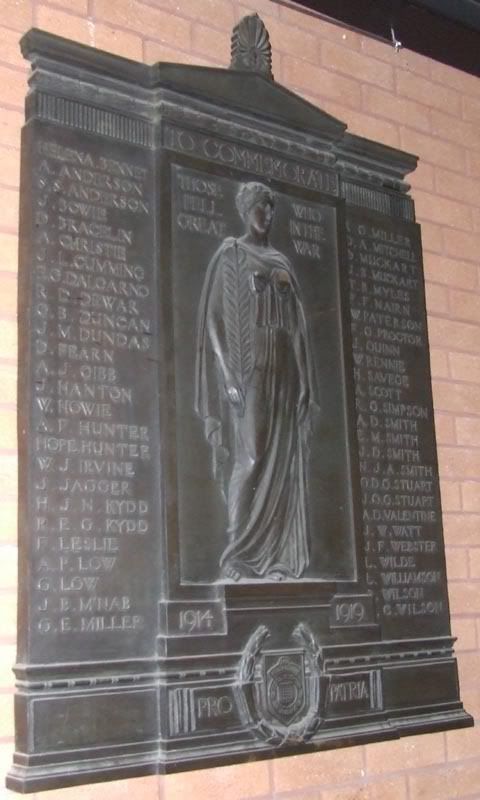
Arbroath High School memorial. Robert G Miller is the first name on the right-hand column.

As he attended St Andrews University he is commemorated on their memorial. The University also published a Roll of Honour - Miller is featured in it and the photograph of him at the top of this article originates from there.

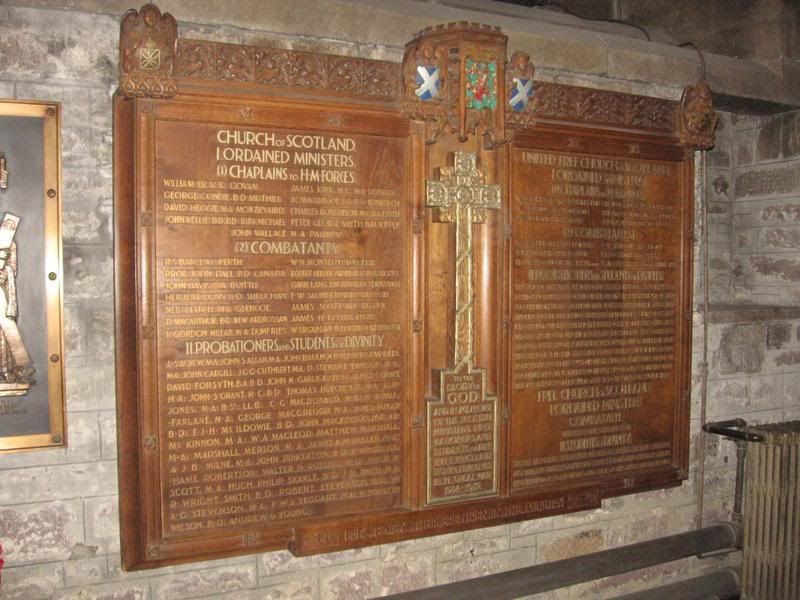
The remaining memorials we have located to him all date from his time in the ministry - the memorial to Ministers, Probationers and Divinity Students which is located in St Giles' in Edinburgh lists him as an ordained minister serving as a combatant.

The memorial to Ministers, Probationers and Divinity Students


His time as assistant minister at Paisley Abbey may mean he is commemorated there - the main Paisley civic memorial lists no names and we do not at the moment have a list of the names on the Roll of Honour for Paisley. Nor do we have a memorial in Paisley Abbey - until we do, we can only assume he may be mentioned there.

There are two final memorials, and these result in three commemorations to Miller. How is that possible?

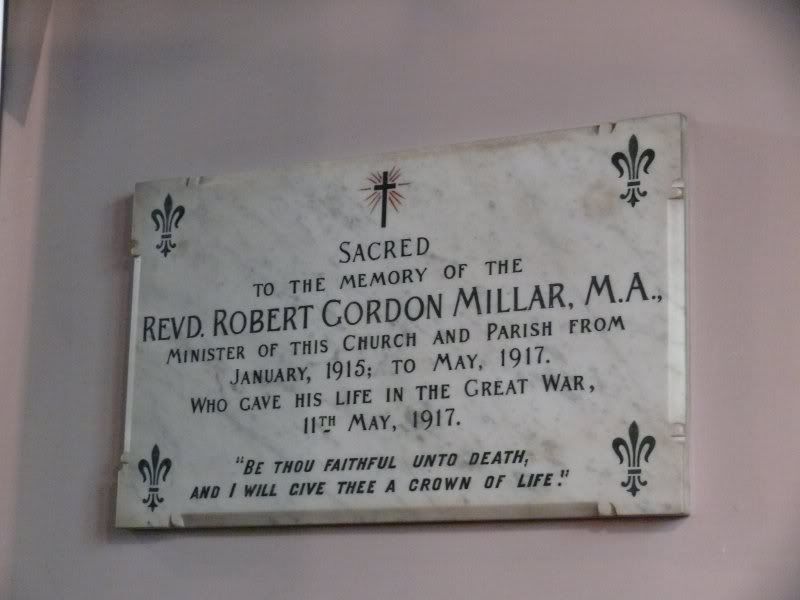
The two memorials in question are both located in St Mary's Church in Dumfries. The first is a plaque solely commemorating Miller.


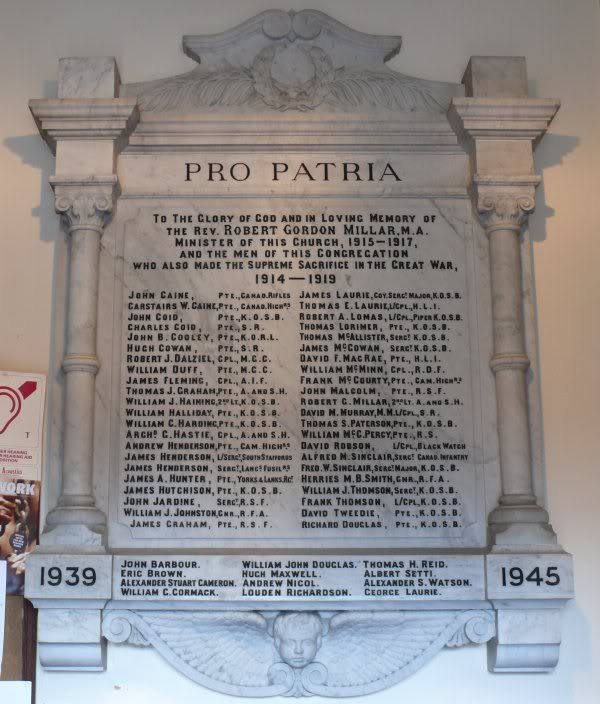
The final memorial is to the congregation of the church, and this is where the extra commemoration comes in: Miller is listed among the fallen of the congregation, but is singled out for special mention at the top of the memorial.


Why that was done we shall probably never know, but what is clear is that Robert Gordon Miller was clearly well thought of, both by the town of his birth and the town where he led a congregation. The number of commemorations certainly indicates that.

However, while Miller is certainly unusual in the number of commemorations, his is by no means the largest number to a single person in Scotland. That, though, will have to be a story for another time...

Monday, 7 February 2011

Featured memorials - Tarbert, Argyll


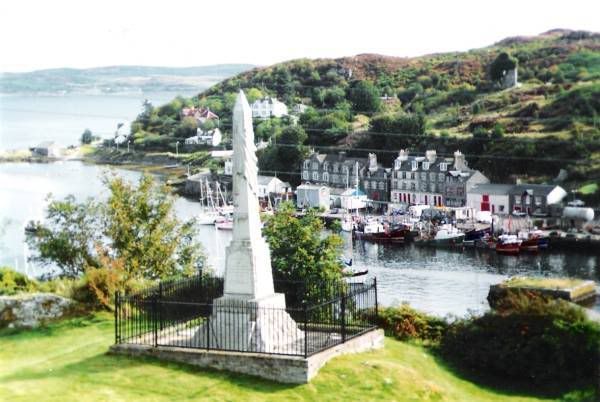
If you looked at a close up photograph of the civic war memorial at Tarbert there is nothing much to distinguish it from a hundred other obelisks in town and villages across Scotland. There are no names of famous people or well known war heroes. It is a typical Scottish war memorial.

What does distinguish it from others is its location. On a quiet, bright, sunny Spring morning there are probably few finer places in Argyll to stand, than beside this war memorial.

As you overlook the village and harbour; as the sun glints of the ripples on East Loch Tarbert and Loch Fyne, you can understand why this particular spot was chosen.

You find memorials like this around the rural communities of Scotland. They are placed in commanding positions above a parish where you can see many of the landmarks the people listed on the memorial would have known so well.

Perhaps anyone visiting the memorial in those years after the war could look around them and remind themselves of one of the things those listed fought for. Their home.

It is ninety years since most of these civic memorials were first erected. There are only a few people still alive who knew those listed on the First World War panels.

The people who actually chose its design and location will all be gone. Perhaps too the reasons for choosing a particular location will have been forgotten. Many Scottish war memorials have been moved from their original location for many reasons; accessibility, road safety, vandalism. But some, like this one at Tarbert should never been moved.

Until you stand beside it yourself on a Spring morning you can get some idea of the view from Google Maps Street View and please have a look at the post on the Scottish War Memorials Project.

Monday, 10 January 2011

Featured Memorials - The stained glass window to Captain Alick Herries, Urr

War memorials take many shapes and forms. Many are simple in design and materials but there are some which are works of art. The most recognised 'artistic' Scottish war memorials are probably statues like Scott Sutherland's Commando memorial at Spean Bridge or Alexander Carrick's Highlander at Dornoch; but some of the most stunning can be the war memorial windows in churches up and down the country.

One which is worthy of singling out here is the memorial window to Captain Alexander 'Alick' Dobree Young-Herries, King's Own Scottish Borderers who was killed in action in the Battle of the Somme in July 1916. It is by Douglas Strachan and is in Urr Parish Church near Dalbeattie. Strachan's most famous commissions are the stained glass windows in the Scottish National War Memorial but he did several private commissions like this one.


The window was paid for by the dead man's father, Colonel W. D. Young-Herries of Spottes, Dalbeattie and was erected in the church in April 1921. As with many church windows the scene is biblical and this one shows the Crucifixion.

A small plaque was placed below the window by Colonel Young-Herries to commemorate his father who laid the foundation stone of the church, and his son Alexander. At the bottom is has the inscription ""Forgetting those things which are behind. I press toward the Mark"" which is taken from Philippians 3:13

Alick Herries is also commemorated on the Haugh of Urr memorial, and Springholm War Memorial, and has another memorial in St Ninian’s Episcopal Church, Castle Douglas. It is his original wooden grave marker cross which was given to his family by the Imperial War Graves Commission when it was replaced by a headstone in Dantzig Alley war cemetery in Mametz, France.

According to Paul Goodwin, Captain Herries was educated at Eton and Cambridge; he was prominent in the boy scout movement, rowing circles and was a devout churchman.

Captain Alexander Dobree Young-Herries , King's Own Scottish Borderers

Saturday, 1 January 2011

The Scottish Soldier in Bronze and Stone

Happy New Year!

As the first post of 2011 we thought a small treat was in store.

Below is a short film created by Adam Brown, showcasing some of the memorials on Scotland. We hope you enjoy it!