Showing posts with label First World War. Show all posts

Friday, 22 July 2016

Private war memorials in churches

Just south of Dunnotar Castle in the old county of Kincardine is the small village of Catterline. There is no civic war memorial in the village but there are memorials in the Church of Scotland and Episcopal Church to the men of the village who lost their lives in the World Wars. The cross in the churchyard of St James’ Episcopal Church lists eight First World War names and one for the Second World War. Like many church memorials is lists only names and gives no other details such as rank, unit or date of death to help anyone researching the names. There are also two men with the same name - William Stephen - which is always a challenge when there are no other details. 

Church War Memorial, St James' Catterline
Luckily, inside the church is a private memorial to one of the William Stephens with more information to help identify who he was. 

Private Memorial in St James', Catterline
Unlike civic memorials or other public memorials, privately purchased memorials often have a lot of information on them. They can be simple memorials such as an inscription on a headstone of they could be a brass or marble plaque on a church wall; or sometimes they are stained glass windows or other church fittings. Private memorials often give details of the cause and place of death and family information. Sometimes they will give the citations for gallantry awards or their war service before their deaths. A private memorial such as the one to William Stephen should be a very useful source of information for researchers then.  

The one in Catterline Church certainly has plenty of information. It records William Stephen’s rank, ship, next of kin, date of death and age. It was erected by the officers and engineers of the Australian Transport ship A.49 – a ship used to ferry Australian service personnel and cargo. Engineer Stephen had been in the crew of the SS “Seang Choon” before it had been requisitioned in 1915 as the HMAT 49 and had remained on the ship – still in the Mercantile Marine – when it was under Australian orders.

Engineer Stephen died in early 1917 but a search on the fate of the ship shows it was not lost in early January but in mid-1917. The HMAT 49 was torpedoed by U-87 off Ireland in June 1917. There is also no record of the ship being in any action which would have caused the death of Engineer Stephen.

Stephen’s private memorial records that he died on “Active Service” on  2nd January 1917 but a search on the Commonwealth War Graves Commission database does not show an entry for him, neither does the Scottish National War Memorial database. The CWGC and SNWM have strict criteria for inclusion for men of the Mercantile Marine on their databases. Engineer Stephen may have faced many of the same risks as his Royal Navy colleagues on the high seas but if he did not die as a result of enemy action then he would not qualify for inclusion on the CWGC or SNWM databases. The inscription “Active Service” is a red herring. This is unfortunately quite common on private headstones where ranks, units and dates can all be inscribed incorrectly and send researchers down blind alleys.

As it turns out 2nd Engineer William Stephen did not die on active service. At the time of his death he was not even at sea, he was in Greenwich Hospital and died of Meningitis & Hypostatic Pneumonia. If he had been in the Royal Navy rather than a civilian organisation he would have qualified for commemoration. He is one of many Scottish mariners who did their bit in the war but are not remembered in official records as a war death. However he is still remembered in his home village, and by the Scottish Military Research Group Commemorations Project (SMRGCP)

Friday, 25 July 2014

Celebrating Scotland's disproportionate WW1 deaths

The Commonwealth Games is now upon us, and whilst that means one countdown is now finished for Glasgow another one is entering its final days. On 4th August 2014 the Commonwealth Heads will gather in Glasgow Cathedral for a service of commemoration to mark the centenary of the start of the Great War. There will also be another ceremony later in the day in George Square at the City’s Cenotaph.

A week later on 10th August, the Scottish Government’s own commemoration will take place in Edinburgh - at the Castle Esplanade and then Holyrood Park.

Around both dates I’m sure we can expect social media, online comments and letter pages to be filled with an indignant section of the Scottish population complaining about us celebrating the start of war in which the number of Scots killed was disproportionally higher than the other parts of Britain (26.4% compared to 11.8%).

I guarantee you will see these words and you will see these figures trotted out repeatedly over the next few weeks. With that in mind it’s worth having a look in some detail about the facts behind them.

Celebrating the Start of the War

Some people, and to be fair this isn’t just a Scottish trait, seem to find it highly offensive that the start of the First World War should be commemorated. They consider no centenary event before 11th November 2018 is worthy of commemoration. None of the battles where Scots fought so bravely to defeat the Germans should be marked – The Germans remember were the ones who had invaded and occupied parts of Belgium, France, Poland, the Baltic states, Russia and Ukraine. To some it is only the end of the “futile war” which should be remembered and nothing else. That is nonsense. If we are to learn anything from this  - and Scotland WW100, the Scottish Government’s First World War centenary programme, uses as its tagline “What do we learn from all th1s” (the 1 is their choice, not my typo)  - then we must commemorate the war’s events from August 2014 onwards.

For a list of the events being officially commemorated by the Scottish Government between 2014 and 2019, under the direction of Culture Minister Fiona Hyslop’s Scottish Commemoration Panel, there is a Scottish Government webpage.

Notice I have repeatedly used the words “commemorated” or “commemoration” and not used the words “celebrated” or “celebration”. The use of “celebrate” has been seized on by many with an agenda after a comment by David Cameron, at a speech in the Imperial War Museum in October 2012 after a very successful summer of celebrations across the UK for the Olympics and the Jubilee.

“Our ambition is a truly national commemoration, worth of this historic centenary.  I want a commemoration that captures our national spirit, in every corner of the country, from our schools to our workplaces, to our town halls and local communities.  A commemoration that, like the Diamond Jubilee celebrated this year, says something about who we are as a people.”

It was ill-judged analogy, and Jeremy Paxman amongst others has criticised its use. Since that time, anyone involved in organising official events for the First World War centenary have been preparing for commemorations and certainly not Diamond Jubilee-like celebrations.  

The number of Scots killed in WW1 was disproportionally higher than the other nationalities in Britain

Thanks to two prominent Scottish academic history professors – Niall Ferguson and Sir Tom Devine – we have incorrect figures being quoted as fact by many Scottish commentators and our media. Because the good professors have quoted these figures it must be true. Even Trevor Royle, the Scottish Commemorations Panel’s historical advisor, has recently quoted the incorrect total for our war dead, even though he has been on record as quoting more accurate figures in the past, and admits on page 529 of his First World War chapter in A Military History of Scotland, published in 2012, that “it is impossible to get absolute agreement on the exact number of Scottish war deaths”.

Niall Ferguson first quoted the figure of 26.4% as a total number of Scots killed as a percentage of those who mobilised, on page 299 of his book The Pity of War in 1998 . On the previous page of his book he also said the following:

"The Scots were (after the Serbs and Turks) the soldiers who suffered the highest death rate of the war"

Ferguson cites American historian Professor Jay Winter’s 1986 book The Great War and the British People as his source of data. He compares Scotland’s 26.4% with the figure of 11.8% for the same numbers of dead for Britain and Ireland as a whole.  Winter’s book shows a table on page 75 – Table 3.4, Some Estimates of Military Losses Among Combatant Countries in the 1914-1918 War. The table includes the 11.8% figure for Britain and Ireland, and Serbia and Turkey, but there is no mention of Scotland.

Winter’s figures in his book are based on the statistics in the publications Statistics of the Military Effort of the British Empire During the Great War 1914-1920; General Annual Report of the British Army 1913-1919; History of the War, Naval Operations and History of the Great War. War in the Air. In none of these publications is the figure of Scotland’s war dead quoted. Ferguson seems to have come up with that figure himself but does not explain his calculations. Some fact!

Sir Tom Devine’s figures are in his book The Scottish Nation 1700-2000. (published 2000) on page 309.

"Of the 557,000 Scots who enlisted in all services, 26.4 per cent lost their lives. This compares with an average death rate of 11.8 per cent for the rest of the British army between 1914 and 1918. Of all the combatant nations, only the Serbs and the Turks had higher per capita mortality rates”

This looks quite familiar. 26.4% versus 11.8% and references to Serbia and Turkey.

Unfortunately, Devine does not cite his sources for these statistics and compares the number of Scots in all services - army, navy and air-force - against a figure for British Army deaths.

With neither professor providing the detail behind their calculations we will have to make some assumptions on where they got their figures from.

Devine gives us a figure of 557,000 of Scots who enlisted in all services in WW1 as a basis for his statement.  On page 740 of Statistics of the Military Effort of the British Empire During the Great War 1914-1920, published by HMSO in 1920, we get a figure of 557,618 as the men and women recruited (or “mobilised” as Ferguson would say) in Scotland during the war. This is presumably where Devine gets his 557,000 figure. If anyone knows differently, please let me know.  

So where does Professor Devine get 26.4% from? If you compare the figure of 147,000 - which was the total number of WW1 dead recorded in the rolls in the Scottish National War Memorial (SNWM) in the 1990s - against 557,000, you get 26.39%, or rounded up, 26.4%.

This SNWM total will also give you Ferguson’s figure:

Total number of Scots killed (147,000) as a percentage of those who mobilised (557,618) equals 26.36%, rounded up to 26.4%

Two eminent historians, two ostensibly collaborating statistics and both complete tosh. We can discount the statistics from both men because:

  1. Both professors have derived their figures from the same data. Devine’s statistics do not prove Ferguson’s are true and vice-versa.
  2. The Scottish National War Memorial figure of 147,000 includes many non-Scots serving in Scottish regiments and the double and triple counting of entries. We’ve covered this subject in a bit more detail before in another Blog post.  The gist of it is this; the number of Scottish war dead is likely to be nearer 100,000 - 110,000 than 150,000. One hundred thousand Scottish war dead is the figure Trevor Royle used in his Flowers of the Forest (published 2006) and was also used by Doctor Catriona M.M. McDonald and Professor Elaine W. McFarland in their publication Scotland And The Great War (published 1998).
  3. 557,618 is the total number of Scotsmen and women recruited by the British Army – from 1914 to 1918. On page 740 of Statistics of the Military Effort of the British Empire During the Great War 1914-1920 it clearly states at the top of the list (e) that the figures represent “The provision of men for the armed Forces of the Crown (as far as the Army is concerned)”. It does not include tens of thousands of pre-war Scottish recruits to the regular army, the reserve and the Territorial Force, which is only given as a UK-wide total at the top of the table. It also does not include the Scots who served in the Royal Navy and later the Royal Air Force. It is also missing the Scotsmen in the armed services of the Dominions – Australia, Canada, South Africa, New Zealand and India. Trevor Royle in A Military History of Scotland (2012) says that 690,235 Scots had been mobilised in the First World War but does not give any detail on where he got this figure. I think it’s safe to assume this figure is for Scots in UK forces only and does not include the Scottish diaspora's service. 


So if Devine and Ferguson are wrong and 26.4% of Scots mobilised didn’t die during the First World War, what is the correct number?

Using Royle’s figures of c.100,000 dead and 690,235 served, gives a percentage of 14.4%. Still higher than 11.8%, but nowhere close to 26.4%. 14.4% also compares a total of the dead which includes the Scots diaspora serving in Dominion and Imperial units against a mobilised total for UK units.

If the mobilised figure includes the Scots who served in the Canadian Expeditionary Force, Australian Imperial Force and other overseas forces, the total number of Scots who served in the Great War might be as high as 800k. This would give us a Scottish dead compared to mobilised percentage of 12.5% - less than half Ferguson and Devine’s statistic and much closer to the UK total of 11.8%. It’s worth remembering at this point that the 11.8% doesn’t include English, Welsh and Irish diaspora numbers, so by factoring that in would there actually be any difference between Scottish and UK war dead percentages? Personally, I doubt it.

As a founder member of the Scottish War Memorial Project I have seen thousands of war memorials over the last few years and take a close interest in memorials wherever I go. If I’m in Caithness the First World War memorials certainly don’t have twice as many names as ones I see on memorials in similar sized towns and villages in Cumberland, Carmarthenshire, or County Down.

Devine and Ferguson’s calculations don’t stand up to scrutiny, and they certainly don’t add up when you are standing in front of any tragically long list of names carved in stone.

Wednesday, 6 November 2013

Lies, damned lies, and statistics

It was interesting to see two articles in Scottish newspapers today about the commemoration of the First World War. One was by Joan McAlpine MSP in the Daily Record and the other was by Alex Massie in The Scotsman

Both writers came to different conclusions but in both cases they used incorrect and widely quoted statistics about Scotland and the Great War.

The first is the number of Scottish WW1 war dead. This is often quoted as 150,000. This figure is taken from the total number of war dead recorded in the rolls of honour in the Scottish National War Memorial. Researchers are still finding names to add so the current total is just over 147,00 names.

This figure is based on all the names in all the rolls. That means the men of the Lovat Scouts who died in Salonika after December 1916 are recorded in two rolls - The Lovat Scouts and the Queens Own Cameron Highlanders - because between then and the end of the war they were the 10th Bn Cameron Highlanders. There were several other yeomanry regiments in the same situation; Black Watch battalions of Scottish Horse and Ayrshire Yeomanry in the Royal Scots Fusiliers. All these men died once but are recorded twice.

Many men served in more than one regiment during the war for a variety of reasons. A man may have enlisted in the Highland Light Infantry, transferred to the Royal Scots and by the time of his death be serving in The Northumberland Fusiliers. One soldier, one death but three entries in the rolls of honour in Edinburgh Castle.

There is a roll specifically for Scottish soldiers serving in English regiments but there is no roll for Englishmen serving in Scottish regiments. Each bay in the Scottish National War Memorial for a Scottish infantry regiment records the men who served in them irrespective of nationality. The men from Manchester who served in the Royal Scots, the Dubliners in the Black Watch, the Leicester men in the Seaforth Highlanders are all counted as Scots in the SNWM. If they happened to serve in two regiments they are double-counted too.

So if there weren't 150,000 Scottish war dead in the First World War how many did actually die? There is no accurate figure but it's probably around 100,000 - 110,000. However until all the post-war dead who died of wounds into the 1920's are found and counted an accurate figure is still impossible to determine.

We now come onto the second statistic. The five thousand war memorials which the Scottish Government have set up a £1m fund to help restore is based on a figure taken from Wikipedia.

A civil servant tasked with a press release must have gone onto Google, typed in "Scottish War Memorials" and got this Wikipedia page. At the time the figure of total Scottish war memorials was given as between 5,000 and 6,000. This had been based on one-tenth of the estimated UK total of war memorials provided by the Imperial War Museum's United Kingdom National Inventory of War Memorials (UKNIWM). I know this because I wrote the Wikipedia page when that number was 55,000.

In the last couple of years the UKNIWM has revised its figure to 100,000 and the Scottish War Memorials Project has estimated that there are 8,000 to 10,000 war memorials in Scotland based on the comprehensive recording work done in Dumfries & Galloway. This figure includes all Scottish war memorials, not just the ones erected after the First World War.

In the SWMP we categorise our memorials as civic, church, unit, school, individuals and others. There are just over 1,400 civic war memorials in Scotland, the memorials paid for and erected by locals and used as the focus of remembrance by communities each November. Of that figure 1,200 are on high streets and in prominent locations in our towns and villages across Scotland. These 1,200 Celtic crosses, obelisks, cairns and statues are the ones the First Minister had in mind when he launched the War Memorial Restoration Fund but they are only a fraction of the memorials in our country.

There will be many more newspaper articles about Scotland in the First World War in the months to come, lets hope that as the centenary approaches we see a little less reliance on Wikipedia and a lot more accuracy.

Tuesday, 19 February 2013

The City of Glasgow Police War Memorials

We are happy to announce the publication of the City of Glasgow Police War Memorial booklet.

The memorials to the Glasgow Police are on display in the Glasgow Police Museum, and Research Group members John and Margaret Houston have been researching the names listed on the memorial.

We are please to publish their research,and we would like to congratulate them on their hard work.

The research has been published through online "print on demand" site Lulu, and is available in downloadable pdf format.

Tuesday, 16 October 2012

Bridge of Allan Roll of Honour


As we approach the centenary of the outbreak of the First World War, attention turns to commemorating the servicemen and women who paid the ultimate sacrifice. New publications appear regularly, containing research into those who fought and died in the service of their country.
 
While this is highly commendable, several members of the Scottish Military Research Group (SMRG) feel this does a disservice to the countless Scots who served just as gallantly and after demobilisation returned home to a thankful family.  
 
We believe that those who returned from the war deserve to be remembered just as much as those who died on a foreign field. Many who survived came home with physical and psychological scars and for some their war did not end with the cessation of hostilities; they carried their wounds with them until the day they died, perhaps decades later.
 
As part of our commitment to remembering all those who served in the First World War we are transcribing and digitally republishing rolls of honour from ninety years ago which list the fallen and the survivors. While the current focus is on First World War rolls the SMRG also intends to republish rolls of honour from other historic conflicts.
 
The Bridge of Allan Roll of Honour 1914-1919 was published shortly after the end of the First World War and is a fascinating record of the service given by the men of one town in Scotland .
 
The roll includes soldiers, sailors and airmen. It mentions those decorated for acts of gallantry and those who died on land, at sea and in the air. There is no rank or class divisions in the list; all men are listed equally from the highly-decorated colonel serving as an Aide-de-Camp to the King, to the humble private who did his own bit in achieving the final victory.
 
This rare out-of-print roll of honour is now available to download from the Scottish Military Research Group by following this link: 

Monday, 9 April 2012

The First Battle of the Scarpe - On this day in Scottish Military History - 1917

The attack and capture of Vimy Ridge by the Canadian Corps ninety-five years ago will be in the news today. Five thousand Canadian students and the Governor-General will be among the many paying their respects at the magnificent memorial which stands on the ridge and commemorates the eleven thousand men of the C.E.F. who died on the Western Front and have no known grave.

Vimy Ridge was just one part of a larger offensive which started on 9th April 1917 and would last until 16th May. It would also involve thousands of soldiers from Britain, Australia, New Zealand, South Africa and Newfoundland (this island colony was not actually part of Canada until 1949).

On the same day the four Canadian divisions attacked Vimy Ridge the three Scottish Divisions on the Western Front were also in action around Arras as part of Third Army, in what is officially known as The First Battle of the Scarpe (after the River Scarpe which runs through the centre of the battlefield). 

15th (Scottish) Division was in VI Corps, while 9th (Scottish) Division and 51st (Highland) Division were in XVII Corps. In total fifty-two Scottish infantry battalions across several divisions, including the three Scottish divisions and 2nd, 3rd, 4th, 5th, 7th, 30th, 33rd and 34th Divisions, fought at Arras during the offensive* 

In fact since thousands of Scotsmen enlisted in the Canadian Expeditionary Force there were probably more Scots in action around Arras on this day ninety-five years ago than Canadians. 

One particular Scottish regiment paid a heavy price in the Arras Offensive. All the battalions of the Seaforth Highlanders on the Western Front were in the front-line on the first day. The three Territorial Force battalions - 1/4th (Ross-shire); 1/5th (Sutherland and Caithness) and 1/6th (Morayshire) all served in the 51st (Highland) Division. The 1/4th suffered two hundred casualties, the 1/5th three hundred. 

The 7th (Service) and 9th (Pioneers) Battalions served in the 9th (Scottish) Division and the 8th (Service) Battalion was in the reserve in 15th (Scottish) Division.

The regular 2nd Battalion was in the 4th Division and on 9th April it advanced four and a half miles inside German lines. It was too good to last and two days later at Fampoux the German counter-attack cost the 2nd Seaforths five hundred and twenty six casualties or ninety-three percent of their strength. One of the casualties was Lieutenant Donald Mackintosh whose bravery on that day would earn him a posthumous Victoria Cross. 

When it came to picking a spot on the Western Front after the war to erect the Celtic Cross war memorial to the eight thousand four hundred and thirty two Seaforth Highlanders who died in the First World War it was the site of the 2nd Battalion's heavy casualties at Fampoux which was chosen  - at the heart of the Battle of The Scarpe where seven of the eight front-line battalions of the regiment were in action on the same day**. 
Seaforth Highlanders
War Memorial, Fampoux

Not far away from the Seaforth's Celtic Cross at Fampoux is a massive and very Scottish Cairn***. It is the First World War memorial to the 9th (Scottish) Division. Like the Seaforths the sacrifices of the Division at places like the Roeux Chemical Works made Arras the choice of location out of all the battles the Division had been in; from Loos in 1915 to the final offensives of 1918. Its inscription commemorates one Scottish division but its sentiment could be applied to the tens of thousands of Scots who served near Arras on 9th April 1917 and the bloody days which followed. 

When you hear about the Canadians on Vimy Ridge today then also...

Remember with honour
The 9th
Scottish Division
Who on the fields
Of France
And Flanders
1915-1918
Served well

Unveiling of the 9th (Scottish)
Division War Memorial


Notes
* Not included are 2nd Dragoons, Royal Scots Greys in 2nd Cavalry Division; 4th Regt South African Scottish in 9th Division; the four Tyneside Scottish battalions in 34th Division; London Scottish in 56th Division and the men serving in the artillery, engineers and other corps recruited in Scotland and attached to the Scottish divisions.
**The other battalion - 1st Bn Seaforth Highlanders was on the front-line in Mespotamia on 9th April 1917
*** In 2006 the 9th (Scottish) Division memorial was moved a short distance from its battlefield location at Athies to a location next to Point du Jour British Military Cemetery to accommodate road improvements.

Sunday, 25 March 2012

Help needed to locate a relative

We were recently contacted by William Nicol, who advised us he had come into possession of a First World War "death plaque" named to Alexander Niddrie Waugh.

The Memorial Plaques were presented to the next of kin of all those who had died in the First World War. Many are still prized possessions of the family, but many more can be found for sale, particularly on Ebay where they can vary in price dramatically, depending on the circumstances.

William would be keen for this particular plaque to be returned to the family, and so we're hoping that someone out there might have some information that could help us to locate a living relative of Alexander Waugh.

The Commonwealth War Graves Commission records some information about Alexander which might be useful:

WAUGH, ALEXANDER NIDDRIE

Rank:   Private
Service No:31332
Date of Death:24/04/1917
Age:20
Regiment/Service: Royal Scots, "B" Coy. 2nd Bn.
Grave Reference: IV. C. 26.
Cemetery: FAUBOURG D'AMIENS CEMETERY, ARRAS

Additional Information: Son of John D. Waugh, of 11, Harley St., Ibrox, Glasgow.


Alexander is also listed on the City of Glasgow Roll of Honour, under the address given for his father above.

Can you add some detail to help us find any living relatives? Did Alexander have any brothers or sisters? And if so, are there any of the family still around today?

You can contact us at the usual email address and we will pass any information received on to William.

Wednesday, 14 March 2012

Advance notice of the annual Royal Scots Gretna Rail Disaster Service


From the Leith Neighbourhood Partnership's website. Advance notice of an annual remembrance service:


Royal Scots Service

Gretna Rail Disaster

Saturday 19th May

Rosebank Cemetery

10-30am.

(Assemble 10am. Pilrig St. Entrance)

Annual Service of Remembrance at the Royal Scots Memorial in Rosebank Cemetery, where 214 men of the 1/7th Leith Royal Scots are interred as a  result of the horrific Gretna Rail Disaster on the 22nd May 1915.

We use the nearest Saturday to the Disaster date which will be the 19th May 2012 meeting at 10am. at the Pilrig entrance to Rosebank Cemetery, we shall then proceed to the Memorial for a 10.30am Service.  With so many groups and associations committed throughout the City on Armistice Day (11th November) we wish to hold a "Remembrance Service" when people are more readily available.

This service will allow... "Leithers".... ex Royal Scots'...ex Service men and others an opportunity to show their respects. Prayers will also be said for our forces serving in Afghanistan and their families, and the children who also died at Quintinshill.

Please come and show your respects.

Further information:  Revd. Ray Williamson  Tel: 07548740250

Monday, 23 January 2012

World War I memories revived with moving Far, Far from Ypres at Celtic Connections

A review from the STV website about a concert held at the weekend.

I have the original CD and it makes for fascinating, and at times, very moving, listening. I would recommend you seek out a copy.

Far, Far from Ypres is one of these collaborations that could only take place at Celtic Connections, though when the singers walked on stage uniformly dressed in black it was hard not to imagine them as a classically trained and rehearsed choir. Participants had queued up to offer their services, including Scottish folk legends such as Barbara Dickson and Dick Gaughan, whose Why Old Men Cry was one of many highlights. The show was put together by Ian McCalman, who along with Stephen Quigg, Ian Bruce, and narrator Ian Anderson, kept the show moving through the years of WWI as seen through the experiences of soldier Jimmy MacDonald and his fellow Scottish soldiers in the trenches.

Anderson’s reading of letters, diaries and the beautiful poem In Flanders’ Fields by Major John McCrae gave continuity and perspective on the history, experiences and music of the trenches, which included old favorites Pack up your Troubles in your Old Kitbag, Goodbyee, and It’s a long way to Tipperaray, and hymn parodies When this Bloody War is over and Whiter than the Whitewash on the Wall. Then there were the music hall favorites If you were the only Girl in the World and Roses of Peccary, and more recent songs such as Eric Bogle’s No Man’s Land and Judy Small’s Mothers, Daughters, Wives.

I was particularly impressed by the singing, which combined powerful solos, robust melody and beautiful harmony and told stories of excitement and hope, suffering and endurance, humour and escapism, fear and disillusionment in the words of those involved in the horrors of the Western Front. Scotland suffered 140,000 losses, not a large number in comparison with other countries, but a bigger proportion than any other nation, including seven Heart of Midlothian footballers, and an even more disproportionate number of Highlanders, whose contribution was beautifully recalled in the beautiful Gaelic song An Eala Bhan (The White Swan) by Sineag MacIntyre.

There were a few rough edges - understandable in a show with hardly any rehearsal - but the singing was powerful, the sound quality was excellent and the words were crystal clear. On top of (or rather behind) all this, was the projection of images of the war by Pete Heywood, who managed to link appropriate pictures to the songs, while never taking away from the centrality of the music and words. Sadly there were no cameras to capture this unique event, but the music was recorded, and a fuller version from 2007, remains available on CD from Greentrax.

Far, far from Ypres was a fitting memorial to the Scottish contribution in the First World War, and without being overtly political, it powerfully reminds us of the horrors of war and the individuals and communities touched by it. It ended with the personal story of Harry Lauder, whose own son’s death inspired his signature song, Keep Right on to the End of the Road.

Thank you Celtic Connections for taking this project on board - the sell-out audience showed their appreciation with a standing ovation, and I’m sure there are other themes that could lend themselves to similar treatment!

Friday, 13 January 2012

Remember the humble beasts


'War Horse’ is released today. Hollywood has taken a children’s book (via a West-End and Broadway play) and turned it into a big budget movie. If you go to see it then expect lavish shots, large-scale battle scenes and to be squeezed through an emotional wringer.


It’s a no-brainer what the film is about; it highlights the use of horses in the First World War. Millions of horses were used by all countries fighting in the war and for Britain which was campaigning across Europe, Africa and the Middle East there were more than just horses used. Mules, camels, elephants, dogs and carrier pigeons were just some of the animals used and abused by our armed forces during the war.

When it came to creating the Scottish National War Memorial in the 1920s the designers wanted to capture in stone, bronze, wood and glass all aspects of the war. They remembered the Scottish regiments; the corps; the sailors and airmen; the nurses and civilians. In short, all the men and women who's lives were lost due to the War. They also remembered the animals.

Edinburgh artist Phyllis Bone was chosen to sculpt the heads of the beasts of burden who served and died alongside the soldiers on all fronts during the war. If you visit the Scottish National War Memorial in Edinburgh Castle cast your eyes up the pillars of the Hall of Honour and you will see Bone’s work. She carved animal heads for the pillars and one carving at your feet which is easy to miss - the mice and canaries who were ‘The Tunnellers' Friends’.

Thanks to photographs from 1920's guidebooks you can see them all on the Scottish War Memorials Project without having to visit the SNWM (which you should still do though).

In the shrine to Scotland’s servicemen and women which is overflowing with grand memorials the simple memorials to “the humble beasts that served and died” are some of the most powerful. You don’t need to go to the cinema to see 'War Horse' to get a lump in your throat.

Friday, 11 November 2011

John Binn? - Behind the name

For the last few days we have been giving you some information on a few servicemen listed on Scottish war memorials. Today's name is slightly different because there are no details to give. There is a mystery though.

At St. Madoes in Perthshire there is one name listed which can't be identified.

Trooper John Binn, Royal Scots Greys is the second man listed on the red sandstone Celtic Cross in the village; despite the best efforts of Derek Robertson of Arbroath, and Mark Duffy of Blairgowrie, they can't identify him.

They have tried the Commonwealth War Graves Commission and Scottish National War Memorial databases but to no avail. This could possibly mean one of two things.

1. He was a non-commemoration, or
2. He used an alias

The House of the Binns was the home of Tam Dayell who raised the Scots Greys in 1681 and there is a Binn Farm near St Madoes, so either of them could perhaps account for use of Binn if it is an alias.

He's not listed on the Royals Scots Greys memorial in Edinburgh either so maybe he died after the war and that is why his not commemorated?

Hopefully at St Madoes today, or on Sunday when they have their Remembrance Day service there will be someone there who knows who Trooper John Binn was.

Thursday, 10 November 2011

Midlothian Fallen - Behind the names

We have been running a short series of behind the names on the Blog, but Ken Bogle of Midlothian Libraries has delved into a few of the names on some Midlothian war memorials and today we are using the article he contributed to yesterday’s Edinburgh Evening News

A roll call of local heroes

Published on Wednesday 9 November 2011 13:46

MORNING had dawned over France, the skies were bright and clear, the air crisp and fresh. A perfect day, perhaps, if not for the bloody nightmare of war.

Young 2nd Lt Ian Gilmour Cameron from Loanhead had slipped into the front seat of the small, single engine two-seater biplane. It was just after 8am, the Battle of the Somme was nearing its conclusion but today, November 9, 1916 – precisely 95 years ago – the teenager’s mission for the Royal Flying Corps was to soar into the skies over northern France, bombs loaded on board to pound the Germans below.

Higher the little plane soared. Lt Cameron – just 19-years-old, the handsome son of a well-respected doctor, a strapping rugby player, winning shot putter and enthusiastic Sandhurst officer – leaned over the open cockpit of the BE2c Royal Flying Corps aircraft number 2506, eyes peeled for signs of the enemy.

Whether he and the pilot sitting behind him were aware they had company, only they ever knew.

What is certain is that Manfred Von Richthofen, the Red Baron, Germany’s “ace of aces” did not go on to earn his reputation for being deadly accurate without good cause – with typical stealth and fatal precision, he’d fly his distinctive red biplane, adorned with its black Iron Cross, above and behind his unsuspecting prey, often with the sun behind him, sneaking up until close enough to blast them from the skies.

By the end of his war, the results of the fighter ace’s prowess in the skies over France would lie shattered on the ground below in the shape of 80 planes downed by his steely eye and rapid reflexes. Among the debris, the corpses of brave allied airmen, their bodies later committed to lie forever on foreign soil.

And on this crisp November morning in the blue skies of northern France, 1916, it would be 2nd Lt Cameron’s turn.

His plane went hurtling down around 10.30am, according to the few records that remain of the fateful incident.

Lt Cameron, pictured not long before he left for France dressed in spats, a jaunty top hat and with a cheeky lopsided grin, who’d won a rugby blue and was school shot put champion, had been shot down.

With his fellow officer’s lifeless body slumped behind him and no doubt pursued by the Red Baron himself, pilot Cameron somehow battled to land the biplane. It’s thought he survived but only to end up caught by his German foes and taken prisoner.

For the Red Baron, flying proud in his distinctive Albatros D11 491/16, it was just another scalp, his eighth in what would be a long and bloody career.

Later, he’d order a silversmith in Berlin to make a cup engraved with the date and details of his Scottish victim and pin the plane’s number – 2506 – alongside other war trophies on the walls of his bedroom in his parent’s home in East Prussia, a ghoulish shrine to his killing prowess.

As for 2nd Lt Cameron, his parents, the widely respected Dr James Cameron and wife Mary, received the dreadful news at their home in Hawthorn Gardens, Loanhead.

Today, his remains lie in a Commonwealth War Grave at Achiet-le-Grand cemetery in the Pas de Calais, a final resting place for 1526 fellow fighting men.

Closer to home, his name is one of 91 inscribed in stone at the entrance to Loanhead Memorial Park. Highly visible, the memorial graces the park’s gateway as a constant reminder to visitors of those who paid the ultimate sacrifice.

But while the memorial bearing the name of the Red Baron’s victim is strikingly obvious, until now only a few to pass under it could surely know who Ian G Cameron really was. Or, indeed, any of the no doubt equally moving and tragic stories behind the names of the fallen etched into stone, copper and in stained glass war memorials scattered around Midlothian.

However, as the clock ticks down to the poignant centenary in 2014, marking the start of the “war to end all wars”, Midlothian Council has embarked on an ambitious challenge to track down as many of the war memorials within its modern boundaries as possible and bring them vividly to life by unmasking the people and the stories behind the names.

Already, researchers from the council’s Local Studies office have unearthed fascinating and long-lost details – some thrilling and dramatic, like the Red Baron’s encounter with Ian Cameron, others deeply moving in their simplicity, such as the brief but poignant story behind Andrew Watson of the Royal Scots, whose name also takes its place on Loanhead park’s memorial. “He was just an ordinary young man of his time,” says Ken Bogle, Midlothian’s local studies officer and archivist. “He worked in the local paper mill and was a committed Christian, who sang in his church choir and taught Sunday school.

“He joined the Royal Scots and went to Gallipoli in 1915 where he lasted less than two weeks. His body was never found. Like thousands of others, he never stood a chance.”

The briefest of details of Andrew’s fate emerged in a postcard found by a collector in Stirlingshire and forwarded to Ken to help with his research.

That, and the picture of the young man, posing in his Sunday best, a flower in his buttonhole, his dark hair carefully parted and a solemn look on his face – perhaps etched with concern for the hell that lay before him – help paint a vivid picture of the real people whose lives were sacrificed in the name of freedom.

As does the heartrending story behind two names that appear one after the other on Dalkeith’s war memorial.

George and Mary Allan of the town’s High Street sent three of their sons to war.

Robert was severely wounded in action. As for Tom and Willie, news of Willie’s death arrived in the morning post and the same evening came the telegram informing the grieving parents that Tom, too, was dead.

Likewise, the striking stained glass window that serves as a war memorial within Crichton Parish Church holds a similar story of family anguish. Brothers Charlie, John and Willie Flynn, who lived at Crichton Mains farm, were all killed.

Imagine, too, the heartbreak for the parents of Royal Scots privates David and George, and Corporal Tom Webster, brothers named together on the Glencorse war memorial.

“Stories like that are very moving to read,” says Ken. “To lose three sons would be terrible but, of course, not unique. It happened across the country.”

So far, the team has drawn up names from around 60 memorials located in the district, including one from Penicuik Co-operative Society, which was rescued from a skip and efforts made through researching historical documents, old newspapers and records to piece together at least a little background to the person behind each name.

The aim, explains Ken, is to ultimately create a Midlothian Roll of Honour.

And with some memorials now long forgotten, lost or hidden from public view in private buildings, it is hoped the public can provide vital information to help track them down and make the roll as comprehensive as possible.

One memorial known to have existed but now lost once honoured the dead at Bonnyrigg Town Hall. Another, long gone, used to grace the entrance of Dalkeith High School – no doubt listing the names of former pupils and staff who gave their lives on the field of battle.

“We’d like to find out more about the people named on the memorials, who they were, where they lived, how they died,” says Ken.

“Did they play football for a local team, what schools they went to? Maybe a photograph – we know people have stuff in the attic, it might be what we need.”

The question for some – even in this most poignant of weeks when the nation pauses to honour those who gave the ultimate sacrifice for freedom – might be “why?”

“Of course, there is no one left alive from the First World War but it’s not really consigned to history, it’s still very much alive and very poignant,” says Ken.

“It’s the sheer scale of sacrifice and the fact that so many people were affected.

“Every family has some story or connection with the First World War, so everyone is involved in some way. It had such a huge impact.”

* Anyone with information about lost memorials should contact the Local Studies team on 0131-271 3976.

Wednesday, 9 November 2011

Dunoon school pupils investigate Christmas truce death

The BBC reports on Dunoon school pupils investigating the death of a local man on Christmas Day 1914.


5th Scottish Rifles man Walter Smith was shot by a German sniper on 25th December 1914, one of the few men to be killed on a day generally observed as a truce on the Western Front.


More of the story can be found on the BBC website

Wednesday, 21 September 2011

Wartime Stuartfield Gun found in Aberdeenshire quarry

A very interesting news item from the BBC today. Many villages and towns had a captured gun on display, and it was thought that many of them had been melted down to re-use the metal in the Second World War. It seems the people of Stuartfield instead buried theirs in a quarry!

http://www.bbc.co.uk/news/uk-scotland-north-east-orkney-shetland-15003303

Saturday, 10 September 2011

The Big Picnic - Govan

I was lucky enough to see Bill Bryden's 'The Big Picnic' during its original run, in fact I came across the programme recently. It was quite a spectacle even though the pedant in me didn't like 'New Army' men being at Mons. However it was set on a truly epic scale; originally in a huge old shipyard engine shed and not a theatre. That allowed the production crew to build a section of trench and no man's land.

One scene particularly stands out in my mind from near the end of the play. An islander who enlisted in Glasgow sings the 23rd Psalm in Gaelic. It was one of those moments when the hairs on the back of your neck stand up.

A theatre company made up of young Glasgow students called Shoogalie Road chose 'The Big Picnic' as their first big show and put it on for the first time in seventeen years. They also went back to Govan to put it on.

Unfortunately the show has been and gone, it was on the 7th and 8th September, so we can't plug it. Instead we'll publish the very favourable review that they got in 'The Scotsman' here

THE BIG PICNIC - PEARCE INSTITUTE, GOVAN
By Joyce McMillan. Date: 10 September 2011

REID Kerr College, Langside College, Telford, Coatbridge, and the University of the West of Scotland: recession or no recession, Scotland's colleges keep churning out students with a burning interest in theatre, and a determination to build careers for themselves.

To judge by their latest production at the Pearce Institute in Govan, though, the new Glasgow company known as Shoogalie Road must be one of the most ambitious graduate groups in Scotland, in that they've chosen, with the consent, support and first-night presence of the playwright himself, to tackle Bill Bryden's huge 1994 epic The Big Picnic. The play tells the story of a group of nine working-class Govan men who join Glasgow's famous Highland Light Infantry at the outset of the First World War, and are plunged into the hell of the trenches. It also keeps an eye on the story of their wives and womenfolk, trying to keep the home fires burning back in Glasgow; and it remains a well-researched and moving, if slightly predictable, slice of Glasgow working-class history, which resonates powerfully in the local setting of the Pearce, a focal point of the Govan community since 1906.

Directed by Jemima Sinclair and Liam Lambie – who also adapted the text – this young production of Bryden's play is never flawless; all of the actors have a tendency to lose control of their voices in moments of high emotion, and there is too much aimless shouting. At its best, though, it combines some impressive acting with a fine soundscape, and an outstanding grasp of how to use a large cast – there are 17 on stage – to create memorable stage pictures; and although there are some theatrical events in Scotland this week which achieve a higher professional polish, there are few driven by such an urgency to tell a tale which should never be forgotten, and by such a powerful emerging sense of theatrical poetry, in telling it.

Monday, 5 September 2011

Fans plan new Hearts war memorial

An article from the Edinburgh Evening News about a new memorial for McCrae's Battalion. Would it be wrong to point out that McCrae's Battalion already has a memorial in Edinburgh? It's in St Giles Cathedral - maybe they should go and have a look for it. And if it's to the team as they say, then there's a memorial to the men from Hearts at Haymarket...

A New memorial to the Hearts players who fought and died in the First World War could be created outside Tynecastle.
Hearts supporters' groups have come together to launch a bid to raise £60,000 for a new memorial to the famous "McCrae's Battalion" or "footballer's battalion", which took part in the Battle of the Somme.

The 600 men that were part of the battalion included all 13 players in the Hearts first team of the time, which had been at the top of the table when they agreed to fight.

Now it is hoped that a statue, likely to take the form of a soldier with a football, can be created outside the club's home ground to recognise the role the club's staff played on the battlefield.

A group of fans have come together to raise money under the name of the 1914 Memorial Trust.

Steven Kilgour, vice-chairman of the new trust, said: "This was a unique team not only to Hearts but to Scottish history and this will be a lasting tribute to them. We don't want a war memorial as such, but something to commemorate the actual team."

The Hearts players that took part formed the backbone of the 16th Royal Scots, later dubbed the "footballer's battalion". The majority never returned.

Many players and officials from other clubs took the lead of the Hearts squad and signed up to the 16th Royal Scots. On the first day of the Battle of the Somme, three of the Hearts players were killed along with 21,000 others.

Gorgie councillor and former Lord Provost Eric Milligan said: "Every supporter in the world thinks there is something special and unique about their football club but I do not think there is any football club anywhere that has a story that surpasses the story of Heart of Midlothian Football Club.

"It stands unique in the world with a rich history that is not just about the football field but a lot more than that and those players that took part in the First World War are a big part of that."

Thursday, 25 August 2011

Motivated by family's sacrifice

We've covered the story of the Cranston family on the blog before.

Here is an update from the East Lothian Courier

Motivated by family's sacrifice

Bryan Copland • Published 25 Aug 2011

A DESCENDANT of a Haddington family which was decimated during the First World War will next month travel to the town from Australia in his quest to have the family's loss commemorated.

Stuart Pearson, from Sydney, Australia, is a distant relative of the Cranston family - which lost four of its nine sons at war and another two were horrifically injured. Only one of the seven who went to war returned unscathed.

It is widely believed that this may rank among the most significant sacrifices made by a Scottish family in the Great War.

Mr Pearson has never been to Scotland before but has been in regular contact with local author and historian Bob Mitchell - with whom he is co-writing a book about the Cranstons - as well as the town's community council and East Lothian councillors.

A reunion of all the Scottish descendants of the Cranstons will take place on Saturday, September 17, while another Australian descendant will also attend.

While here, Mr Pearson also wants to discuss the possibility of an appropriate memorial to the family.

Mr Pearson has previously suggested that a stone cairn, or naming a street or local park after the family, would be a suitable tribute - though Haddington Community Council has been reluctant to provide a dedicated memorial without putting the loss into context, as it is concerned it may overshadow other families' losses during the war.

Mr Pearson said: "A previous request [for a memorial] was declined but this Antipodean descendant would like another opportunity to present his case, this time in person.

"It is my opinion that this remarkable Haddington family who made such an extraordinary (perhaps unprecedented) sacrifice, suffered such devastation yet ultimately survived should have their story told. They should be commemorated in writing and in stone.

"As we near the 100th anniversary of the start of the First World War, I hope that a memorial to the Cranston family could become a metaphor for every Scottish family's loss during that terrible event."

Monday, 25 July 2011

Royal Scots scrapbook digitised

We've just come across a post on the Great War forum by John Duncan about a project he completed for the Royal Scots museum. This project involved the digitisation of a scrapbook, compiled from newspaper entries for the Great War.

The scrapbook comprises almost 3000 entries for men from the Royal Scots.

You can find a list of the men photographed on the Great War Forum, where you can request a lookup for a particular name.

Another great resource!

Thursday, 30 June 2011

Remains Of First World War Soldier Identified

A news release from the Canadian Department of National Defence on the identification of a First World War casualty. Alexander Johnston was born in the town I was brought up in...


OTTAWA – The Department of National Defence (DND) has identified the remains of a First World War soldier found in Raillencourt Saint-Olle, France, in 2008, as those of Private Alexander Johnston of Hamilton, Ontario. 

“This identification will provide closure to Private Johnston’s family, as well as reassure them that the ultimate sacrifice he made in the name of his country will never be forgotten,” said the Honourable Peter MacKay, Minister of National Defence. “Our Canadian soldier will finally be laid to rest with the military honours that he so rightfully deserves.” 

In July 2008, human remains were discovered in Raillencourt Saint-Olle, France. Found with the remains were two collar badges of the 78th Battalion (Winnipeg Grenadiers). The Directorate of History and Heritage was notified of the discovery in February 2009, and the remains were identified through mitochondrial DNA testing, as those of Private Johnston, on March 31, 2011.

DND has since notified members of Private Johnston's family of the identification. Veterans Affairs Canada will have the responsibility of providing them with ongoing support as arrangements are made and carried out for the final interment. 

Private Alexander Johnston was born in Coatbridge, Scotland on August 20, 1885, and moved to Hamilton, Ontario, in his late twenties. He joined the Canadian Expeditionary Force on January 5, 1918, and was taken on strength of the 78th Battalion in the field on September 4, 1918. Private Johnston died during the Battle of the Canal du Nord on September 29, 1918. His remains will be interred at Le Cantimpré Canadian Cemetery in Sailly, France, in October 2011 with his family in attendance. 

For more information on the Department of National Defence’s casualty identification process, please visit: http://www.forces.gc.ca/site/news-nouvelles/news-nouvelles-eng.asp?cat=00&id=3725.

Sunday, 12 June 2011

William Angus wins the Victoria Cross - On This Day in Scottish Military History, 1915

Today's event is of particular interest to me. William Angus lived in Carluke, the village I currently reside in, and there are many references to him throughout the town: I'll come to them later on.

The events of the 12th June 1915 are fairly well know, but it's worthwhile mentioning the citation for his Victoria Cross again:

"For most conspicuous bravery and devotion to duty at Givenchy on 12 June 1915, in voluntarily leaving his trench under very heavy bomb and rifle fire and rescuing a wounded officer who was lying within a few yards of the enemy's position. Lance-Corporal Angus had no chance whatsoever in escaping the enemy's fire when undertaking this very gallant action, and in effecting the rescue he sustained about 40 wounds from bombs, some of them being very serious"

There are many aspects of the Angus VC story that make it particularly interesting. Some of them are true, some of them have become a little "twisted" after time, and some of them seem so unlikely that you are left wondering if they could be true or not.

I thought that rather than go over old ground, describing in detail the actions of that day, I would instead look at a couple of aspects of the story that have perhaps become muddled over time or are thought of a part of the "myths" of the tale.

One of the main things you are often told is that Angus is the "Celtic VC". The Celtic aspect is a little unclear. It's often described that he struggled to break into the team, and that his appearances were restricted to a mere handful. Other reports state that it was only one game played for them. Contemporary reports, however, state that although he was employed by Celtic Football Club at one time, he never played a game for them.

There is certainly some evidence to back this up. In the Mitchell Library is a book published a few years ago, which lists all the players who appeared for Celtic. It seems fairly comprehensive, even mentioning Allan Lynch, who only ever appeared for Celtic as a trialist - William Angus is not listed in this book. That would seem to suggest he did not play for them.

However, I do not blame Celtic or their fans from "claiming" him as one of their own. He was employed by them - if it was my club I would claim him too.

We are on firmer ground when we discuss the "40 wounds" aspect of the story. Forty wounds seems ridiculous. Surely it was made up?

Well...perhaps not. Take a look at this:


that is a section from the service record of William Angus, available to download on Ancestry. As you can see, that's a fairly serious list of wounds. From what I can read (and deciphering some of the jargon) here's what he received:


  • Gun shot wounds to his right leg
  • Bomb wounds to his head, shoulders and foot
  • Grenade wounds to his left eye socket, leg and arm
  • Bomb wounds to his right eye socket and eye, left side of his body, right thigh and foot
and as you can clearly see, they removed his eye the following month. Notice how all of these entries are plural: "wounds", not wound. Forty wounds? Seems like it's not such a myth.

It was pleasing to me to read that entry from his service record. I've always had an interest in the Angus story. It's a story of one incredible action by a man who by all rights shouldn't have survived.

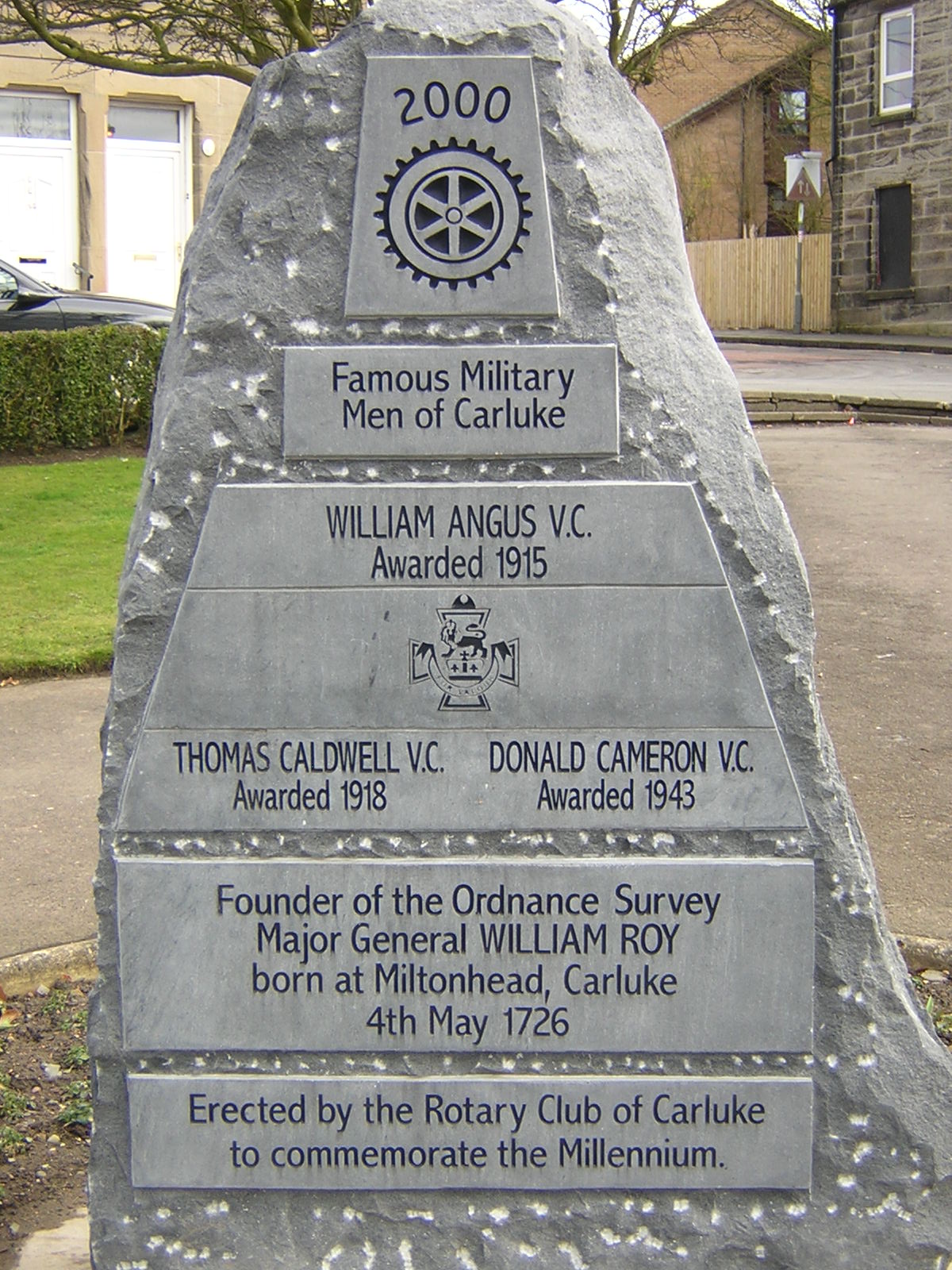
Like I said above, I live in Carluke, and there are references to Angus all over. Carluke is a very small village (albeit larger now than in Angus's time) so it's incredible that it can lay claim to being the home of not one or even two, but three winners of the Victoria Cross. All three are fondly remembered - they all have streets named after them, and there is a stone in the market place where they are all listed.


In addition to this I remember seeing one of the local football teams (it may have been a school team, or a junior side. I'm afraid I didn't make a note at the time) who use an image of the Victoria Cross as their badge, and the recently opened community centre has a focal display of stained glass with images of local landmarks and items of note. One of the panes of glass features three VCs.

Travel slightly farther afield and you can view his medals in the National War Museum at Edinburgh Castle. fittingly they are displayed next to those of Lieutenant James Martin, the man from the same village whose life he saved 96 years ago today.


All this fuss may have embarrassed Angus had he known of it. By all reports he was a modest man and would only tell his story if prompted. Whatever his feelings about it, he was a remarkably brave man, and he deserves to be remembered as an inspiration and example to all.