From the BBC News Website:
Earl Haig dies at the age of 91
Earl Haig, the son of British World War I commander Field Marshal Douglas Haig, has died at the age of 91.
George Alexander Eugene Douglas Haig was born in March 1918 at the time of a major German offensive.
The death of his father - who is buried at Dryburgh Abbey in the Borders - saw him become the 2nd Earl Haig of Bemersyde at the age of nine.
Haig, who was known as Dawyck, was imprisoned at Colditz after being captured during World War II.
He once said that this time as a prisoner had a profound effect on his life.
"I was thus able to prepare myself for the post-war world in which I would play a part quite different from the one which I would have played had the war not happened," he said.
"Ironically, out of the evil that Hitler wrought upon my life there came some good."
That included becoming a long-serving office bearer in numerous ex-service charities.
Among them were the Royal British Legion Scotland, the Earl Haig Fund Scotland, the Lady Haig's Poppy Factory and the Scottish National Institution for War Blinded.
He later became an acclaimed artist and was a president of the Scottish Craft Centre and a trustee of the National Gallery of Scotland.
However, his name was forever linked with his famous parent as was seen in the title of his autobiography, My Father's Son.
In 2006, on the eve of the 90th anniversary of the Battle of the Somme, he spoke out to defend his father's record in World War I.
Earl Haig said he wanted to "set the record straight".
"I believe it has now turned full circle and people appreciate his contribution," he said at the time.
"But it saddens me my three sisters have not survived to see it.
"They died suffering from the beastly attitudes of the public towards our father."
Friday, 10 July 2009


Sunday, 5 July 2009
Robert Burns and the Royal Dumfries Volunteers
We have a "guest author" on the blog for this post. The following article was written by group member Paul Goodwin for our attendance at the Family History Fair at Dumfries last week. I thought it worth posting here to bring it to a wider audience.
Robert Burns was not only a poet and national icon but he was also a Private in the Royal Dumfries Volunteers for the last year and a half of his life. Although brief, his service was dedicated and conscientious but strangely seems to have been ignored by many of his biographers.
In an atmosphere of fear of invasion from France, the Dumfries Volunteers were formed on 31st January 1795 when the inaugural meeting was held in the Dumfries Court House and attended by Robert Burns. At a meeting on 20th February Colonel de Peyster was elected Major Commandant of the Corps by the members. Mrs De Peyster then provided the corps with a flag and Colonel de Peyster commissioned 100 ‘Brown Bess’ muskets from Birmingham. On 21st March, Wellwood Maxwell (probably of Munches near Buittle) was made lieutenant to the second company, in which Burns served. Members agreed to provide their own uniform, serve without pay during the war with France and to have an area of operations not more than 5 miles outside of Dumfries. Burns hated war and would fight if his country were invaded, but for no other reason.
Burns was among 59 members who took the Oath of Allegiance and signed the Rules, Regulations and Bye-Laws on 28th March. The governing body of the corps was a committee consisting of all officers and eight members. The members served a three month term on the committee. Burns served on this committee for a term starting on 22nd August 1795.
His song "Does Haughty Gaul Invasion Threat" (also known as ‘The Dumfries Volunteers’), appeared in the Dumfries Weekly Journal in April 1795.
Burns attended the meetings, the drill sessions, served on the committee and was never fined for absenteeism, drunkenness or insolence as many members, both officers and privates, were. Drills were held for two hours, twice a week and committee service involved supplying the corps with arms and other material. All this work was on top of his excise duties and, of course, his writing. This contrasts markedly with his ‘traditional’ image as a hard-drinking womanizer.
On Monday 25th July 1796, Burns's funeral was conducted with military ceremony. In addition to his own Dumfries Volunteers it included the Cinque Port Cavalry and the Angusshire Fencibles. He was buried in the northeast corner of St. Michael's churchyard, a quarter of a mile from his home. His volunteer unifom hat and sword crowned the coffin. The Dumfries Volunteers acted as the pall bearers, the Cinque Port Cavalry band played the Dead March from Saul by Handel and the Angusshire Fencibles ended the procession with a guard that fired three volleys over the grave.
Strangely, while his writing was often not given the recognition it deserved during his lifetime, his much less known military service was honoured at his funeral.
Once the threat of invasion was past, the Royal Dumfries Volunteers were disbanded in 1802 after only seven years. Thankfully their minute book has survived.
Does Haughty Gaul Invasion Threat?
(The Dumfries Volunteers)
By Robert Burns
Does haughty Gaul invasion threat?
Then let the louns beware, Sir!
There's wooden walls upon our seas,
And volunteers on shore, Sir!
The Nith shall run to Corsincon,
And Criffel sink in Solway,
Ere we permit a Foreign Foe
On British ground to rally!
We'll ne'er permit a Foreign Foe
On British ground to rally!
O let us not, like snarling curs,
In wrangling be divided,
Till, slap! come in an inco loun,
And wi' a rung decide it!
Be Britain still to Britain true,
Amang oursels united!
For never but by British hands
Maun British wrangs be righted!
No! never but by British hands
Shall British wrangs be righted!
The Kettle o' the Kirk and State,
Perhaps a clout may fail in't;
But deil a foreign tinkler loun
Shall ever ca'a nail in't.
Our father's blude the Kettle bought,
And wha wad dare to spoil it;
By Heav'ns! the sacrilegious dog
Shall fuel be to boil it!
By Heav'ns! the sacrilegious dog
Shall fuel be to boil it!
The wretch that would a tyrant own,
And the wretch, his true-born brother,
Who would set the Mob aboon the Throne,
May they be damn'd together!
Who will not sing "God save the King,"
Shall hang as high's the steeple;
But while we sing "God save the King,"
We'll ne'er forget The People!
But while we sing "God save the King,"
We'll ne'er forget The People!
Saturday, 4 July 2009
Ancestry to re-index Soldiers Service Returns
While browsing through Chris Paton's Scottish Genealogy Blog, I noticed a post which might be of interest:
Ancestry to re-index Service Returns
This is welcome news, as one of the most frustrating things about searching for a soldiers papers is the time it takes to track down "your" man - now if only they would make it searchable by service number as well - that would make searching 100 times easier!
Sunday, 17 May 2009
Commercial Bank of Scotland 14-18 Roll of Honour
One of the aims of the Scottish Military Research Group was to make information more available to those who required. To that end we have been carrying out transcribing and digitising of various records, and we will release these at various times.
Some of these records we will release on CD, mainly due to the size of the data and in order to recoup some of the costs involved, but other items we will release as free downloads.
This is the first in our series of free downloads: the Roll of Honour for the Commercial Bank of Scotland. This lists all members of the bank who served in the First World War, as well as those who died in service.
The Roll of Honour lists 578 makes, 99 of which made the supreme sacrifice. The Roll has been fully transcribed, together with all the explanatory and introductory text. It is fully searchable so it is easy to find a particular name.
Original copies of this Roll are hard to find, so we are pleased to make this new version available. It can be downloaded by using one of the following links:
Download via Rapidshare
Download via Sendspace
Please let us know if you experience any problems with these download links via our email address - scottishmilitaryresearch@live.co.uk
Friday, 15 May 2009
Photos
You may have noticed that the photos on the blog appear to be cut off at the right hand side.
I've been looking into it, and I'll admit I have no idea how to fix it.
Anyone got any ideas?
Featured memorials #1
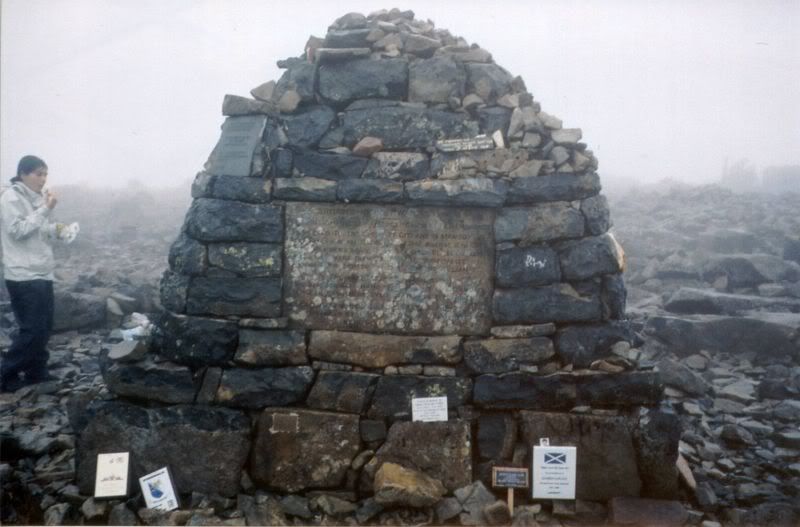
This is a new feature I'll be introducing to the blog, where I highlight a memorial that's of interest, or that I think deserves to be highlighted.
I thought I'd start with what must officially be the highest war memorial in the country, as it's situated at the top of Ben Nevis.
More details on the Scottish War Memorials Project.
SAFHS Conference 2009
The SMRG had a fairly successful day at the SAFHS Conference in Aberdeen - I hope that everyone who visited our stall came away with something of use to them!
There's a slideshow of photos of the day available here. Those of you who know me might wish to play "Where's David?", spotting me lingering amongst several photos!
Subscribe to:
Posts (Atom)