Monday, 7 February 2011

Featured memorials - Tarbert, Argyll


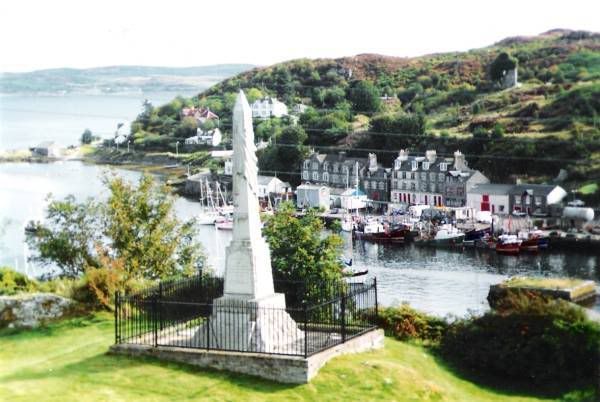
If you looked at a close up photograph of the civic war memorial at Tarbert there is nothing much to distinguish it from a hundred other obelisks in town and villages across Scotland. There are no names of famous people or well known war heroes. It is a typical Scottish war memorial.

What does distinguish it from others is its location. On a quiet, bright, sunny Spring morning there are probably few finer places in Argyll to stand, than beside this war memorial.

As you overlook the village and harbour; as the sun glints of the ripples on East Loch Tarbert and Loch Fyne, you can understand why this particular spot was chosen.

You find memorials like this around the rural communities of Scotland. They are placed in commanding positions above a parish where you can see many of the landmarks the people listed on the memorial would have known so well.

Perhaps anyone visiting the memorial in those years after the war could look around them and remind themselves of one of the things those listed fought for. Their home.

It is ninety years since most of these civic memorials were first erected. There are only a few people still alive who knew those listed on the First World War panels.

The people who actually chose its design and location will all be gone. Perhaps too the reasons for choosing a particular location will have been forgotten. Many Scottish war memorials have been moved from their original location for many reasons; accessibility, road safety, vandalism. But some, like this one at Tarbert should never been moved.

Until you stand beside it yourself on a Spring morning you can get some idea of the view from Google Maps Street View and please have a look at the post on the Scottish War Memorials Project.

Saturday, 5 February 2011

SS "Politician" runs aground off Eriskay - this day in Scottish Military History - 1941

A bit of a tenuous military connection to today's "On this day.." since it is about a shipwreck of a merchant ship due to a storm. However it happened during wartime and the contents of the ship's hold were rationed in the UK at the time.

The ship in question was the Steamship "Politician" which ran aground onto the rocks off Eriskay on this day seventy years ago. Hundreds of merchant ships were lost during the war due to enemy action or an act of God, but this one was special to the locals because amongst its cargo were 28,000 cases of malt whisky.

The ship didn't break up when it hit the rocks and the crew escaped to shore and were taken in by nearby islanders. Word soon spread round the island that 264,000 bottle of whisky were on their doorstep. Soon men from Eriskay and other Hebridean islands were making night time trips to the ship. Apart from whisky there were also thousands of ten shilling notes destined for Jamaica and they too started to disappear from the ship.

A local customs officer was well aware of what was happening and eventually managed to get the hull of the 'Politician' blown up which allowed the forces of nature to complete the job of destroying the ship and what was left of its cargo. He was too late to stop at least 24,000 untaxed bottles of whisky and an undisclosed sum of money making their way into circulation though.

The incident was made into the Ealing comedy "Whisky Galore!" in 1949. Being based on Compton McKenzie's 1947 novel of the same name. In a rare move for the time most of the film was shot in location in the Hebrides with Barra standing in for the fictitious Island of Todday. Here's a wee taster...

Friday, 4 February 2011

The Story Behind the Name: Robert Mavor

Whenever you look at a war memorial, it is important to remember that the men and women commemorate are more than just a name on a plaque. This new regular feature will pick selected names on memorials and tell you a little about their lives.

My research into the Bank of Scotland memorials has also meant researching some of the banks which were incorporated into the Bank of Scotland, later HBOS and now the Lloyds Banking Group.

One such bank is the British Linen Bank. Their memorial can be seen in the Bank of Scotland branch in St Andrews Square in Edinburgh, and one of the names on that memorial is Robert George Mavor, MC.

The British Linen Bank First World War memorial in Edinburgh.

Robert George Innis Mavor was born in September 1891, the youngest son of John and Margaret Mathieson Mavor. He was educated at George Heriot’s School from 1903 to 1907, and served his apprenticeship with the Linen Bank in the Newington branch before being appointed permanently in the Head Office. He was a member of the Institute of Bankers.

He was released for military service by the bank on the 21st October 1915, and was commissioned into the 7th Battalion Argyll and Sutherland Highlanders as a Second Lieutenant.

He arrived in France in October 1916, and in April 1917 he was awarded the Military Cross for his actions at Vimy Ridge. The citation reads:

For conspicuous gallantry and devotion to duty. He took command of the company during the advance at a time when it was held up by machine gun fire. He reorganized the company and handled it with great skill. His fine example and skill enabled the company to gain its final objective.

The Captain of the company concerned wrote to Mavors’ parents, giving them a little more detail about the events leading to his award:

“I was hit in the knee, and unable to move. Things looked black; but your son, on finding I was hit, took command, reorganized the company, and led them forward, clearing out the enemy and taking our objective, for which splendid work he was recommended by the Colonel. It was magnificently done, and he deserves great credit , especially as he was slightly wounded at the time.”

Despite being wounded he was able to continue his duties, but he would not live to see the award of the Military Cross as he was killed in action at Roeux on the 23rd April 1917.

His Colonel wrote to his parents:

“It is with the greatest regret that I have to tell you that your son was killed on the 23rd, while gallantly leading his men in the attack. He was one of the most capable young officers I had, and had already done splendidly in the Vimy Ridge. His name would have been sent in for special mention.”

A fellow officer wrote:

“He went with B Company to attack Roeux on the 23rd, but unfortunately was killed by machine-gun fire in the woods before reaching the village. His men tell me he was slightly wounded, but refused to give up, like the true and faithful soldier he has always shown himself, until he was mortally hit. He is the greatest loss to the battalion as he was loved by everyone, and his work at all times was beyond praise.”

Another officer wrote:

“I knew your son well, and the longer he was with me the more I appreciated his sterling qualities. Always cheerful and willing, his men loved him and would go anywhere with him; an officer can have no finer tribute paid him…in his death the battalion have lost one of their very best officers, and the company, both officers and men, a bright and unselfish companion.”

Robert Mavor is buried in Section I, Row A, Grave 11/16 of Level Crossing Cemetery, Fampoux. As well as being commemorated on the British Linen Bank war memorial in Edinburgh, he is also listed on the memorial at George Heriot's School.
Thursday, 3 February 2011

Lanarkshire FHS talk on the Commonwealth War Graves Commission

Lanarkshire Family History Society's guest speaker for February will be Iain Anderson, Regional Supervisor (Scotland) of the Commonwealth War Graves Commission.

The meeting will be on Thursday 10th February at the GLO Centre in Motherwell. The meeting starts at 7.30pm and visitors are welcome to attend.

Bench named for Gordon Gentle to be unveiled in Glasgow

There will be an unveiling ceremony at George Square at 2pm on Friday of a bench to Fusilier Gordon Gentle of the Royal Highland Fusiliers, who was killed by insurgents in Iraq some years back.

Representatives of the Royal Highland Fusiliers will be in attendance, as well as members of Gordons family.

Tuesday, 1 February 2011

On this day in Scottish military history - 1746, The Jacobites admit defeat at Stirling Castle.

On 17th January 1746 at Falkirk Muir the Jacobites had inflicted a crushing blow on the Government Forces in Central Scotland. In a surprise attack the Jacobites had routed General Henry Hawley's army which was threatening Bonnie Prince Charlie's army which was besieging Stirling Castle.

Once again the highlanders' charge had delivered a victory, but it would be the last time a full blooded highland charge with broadswords and dirks would clear a battlefield. Even while they celebrated their victory and Prince Charles pressed for a march south, the Duke of Cumberland was advancing north with more government soldiers determined to crush the rebellion.

With Scotland in the grip of Winter, and desertions depleting their army, the Jacobite command realised they could not take Stirling Castle before Cumberland arrived. They decided to march to Inverness where they could regroup. With the decision made the Jacobite Army struck camp and continued its long retreat north on this day in 1746.