Friday, 24 April 2009

MoD names WWI mass grave troops

An interesting article on the BBC News website:

MoD names WWI mass grave troops

The Ministry of Defence has released the names of dozens of World War I soldiers they believe may be buried in a mass grave found in France last year.

Burial pits, which date from the Battle of Fromelles on 19 July, 1916, could also contain the remains of at least 20 Scottish soldiers.

Among those named are members of the Cameron Highlanders and the Royal Warwickshire Regiment.

More than 7,000 British and Australian servicemen died in the two-day battle.

SCOTS ON CASUALTY LIST
  • Private John Adam - Royal Warwickshire Regiment - from Grangemouth
  • Sergeant Andrew Allan - Royal Warwickshire Regiment - from Bannockburn
  • Private John Bowie - Oxford and Bucks Light Infantry - from Aberdeen
  • Private Mitchell Collins - Royal Warwickshire Regiment - from Kennoway
  • Private John Cumming - Cameron Highlanders - from Inverness
  • Private Alexander Dryburgh - Royal Warwickshire Regiment - from Werness
  • Private George Galloway - Royal Warwickshire Regiment - from Buckhaven
  • Private Alex Gray - Royal Warwickshire Regiment - Wormit, Fife
  • Private Alexander Loudon - Cameron Highlanders - from Lanarkshire
  • Lance Corporal David Marshall - Royal Warwickshire Regiment - from Perth
  • Private Joseph McGuire - Cameron Highlanders - from Glasgow
  • Lance Corporal John Melville - Royal Warwickshire Regiment - from Perth
  • Private James Melvin - Cameron Highlanders - from Abington
  • Private James Mitchell - Cameron Highlanders - from Coldstream
  • Private Maxwell Mitchell - Royal Warwickshire Regiment - from Falkirk
  • Private Ernest Paton - Royal Warwickshire Regiment - from Forfar
  • Lance Corporal William Richardson - Royal Warwickshire Regiment - from Perth
  • Private William Robertson - Cameron Highlanders - from Edinburgh
  • Corporal David Simpson - Royal Warwickshire Regiment - from Kirkcaldy
  • Private John Smith - Royal Warwickshire Regiment - from Forfar
  • Private David Thom - Royal Warwickshire Regiment - from Forfar
  • As part of the identification process, experts will take DNA samples from the bodies and try to find a family link with the help of the soldiers' relatives.

    The Commonwealth War Graves Commission (CWGC) will begin the process of exhuming and identifying about 400 of the bodies next month.

    The soldiers were buried by their German counterparts in the aftermath of the battle and most of their identifying tags removed.

    A careful cross-referencing of casualty records has already enabled the MoD to produce a pool of possible identities for the soldiers.

    The commission aims to identify the bodies and give them a military burial at a new site near Fromelles, which will be the first war cemetery constructed in 50 years.

    The soldiers will be buried with full military honours, initially as unknown soldiers, then a panel of experts from the Australia and the UK will meet in 2010 to consider the evidence gathered about the soldiers' identities.

    A spokesman for the CWGC said: "The list of names has been released because we need the families to come forward and register their details with the project.

    "It's a slow, forensic process, we have to first check whether the DNA is viable at the burial site and then test it against the families.

    "The graves will then be marked when positive identifications are made.

    "We will ask the families what they want on the headstones and we will take care of that."

    The commission said the new cemetery would be "worthy of the sacrifices made by these men and a place of dignified pilgrimage and remembrance for generations to come."

    Details of all the men believed to have been discovered can be found on the website www.cwgc.org/fromelles

    Tuesday, 21 April 2009

    Memorials in Danger - update

    Quite a bit has happened since I posted yesterday about the condition of the Mains war memorial in Caird Park, Dundee.

    There has been an article in The Courier which can be viewed here. The comments of the Provost John Letford are interesting when he says that "I wasn’t aware of this previously" since this article from 2005 indicates that the condition of this park and the war memorial were made clear to him - quite obviously nothing has been done since some of the graffitti currently on the memorial is dated from 2005!

    The BBC News website have also picked up the story and feature some comments from yours truly, as well as some very pessimistic comments from Councillor Bob Duncan. If it is the case that the memorial can't be saved, then frankly it's up to the council to provide a fitting replacement - they were given custody of the memorial in 1922 and they have failed in their duty to maintain it!

    It remains to be seen what will happen but I think it is clear that this issue will not go away, although I suspect that is what Dundee council would like to happen.

    SAFHS Conference 2009

    A reminder that the annual conference of the Scottish Association of Family History Societies, along with the Scottish Family History Fair, takes place this Saturday 25th April at King's College Conference Centre in Aberdeen. Attendance to the fair is free to the public.

    For more information, visit the SAFHS website at www.safhs.org.uk/SAFHS_Conference.asp.

    The Scottish Military Research Group wil be there, so feel free to find our table and say hello. You can hear about some of our projects and perhaps browse some of the records we'll have on display.

    We hope to see you there!

    Monday, 20 April 2009

    Memorials in Danger #1

    One of the reasons for this blog was to highlight stories and areas of interest that arise from the discussions on the Research Groups forums. One area I wanted to highlight which occasionally arises from the War Memorials Project forum is the number of memorials which perhaps need a bit of care and attention.

    I had been planning to start a regular series of postings to the blog on this very subject, and a recent new addition to the Memorials Project had spurred me on to do it sooner rather than later.

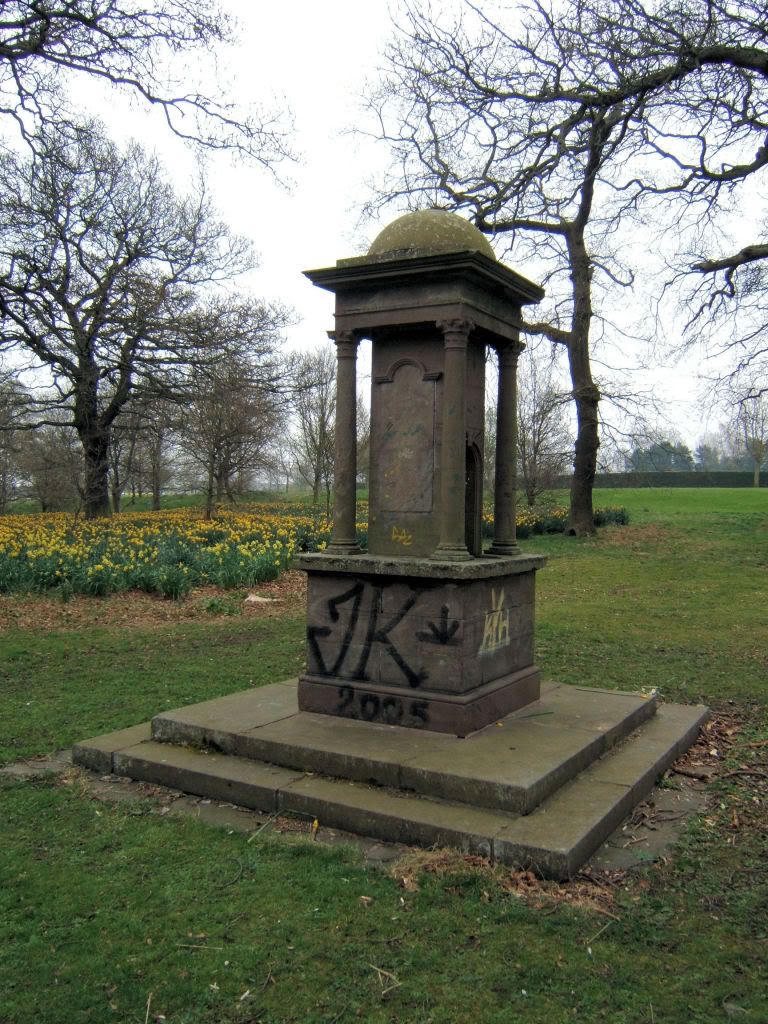
    I had hoped to start with a memorial that perhaps needed a clean, or perhaps required some attention to some names which had become faded. I never thought I would have to highlight a memorial which has suffered so much neglect, damage and vandalism as that of the Mains memorial.

    This memorial is located in Caird Park, Dundee and commemorates the men from Mains who fell in the First World War. At the unveiling, a Baillie Gillies accepted custody of the memorial on behalf of the corporation. I can only think that the corporation, and whichever body succeeded it, has failed in their duty to maintain safe custody of this memorial.

    This is the condition of this memorial now:

    There are further photographs on the Scottish War Memorials Project site which show in greater detail how badly damaged this memorial is.

    It is covered in grafitti, and several of the names will be lost due to damage of the name panel if something is not done soon.

    Fortunately, it seems that the posting of these photographs on the forum has made a few of our members sit up and notice. The thread concerning this memorial contains a great deal of support, and it seems that the relevant council bodies have been notified. Unfortunately it seems that, as in many things nowadays, it may be a question of money which decides if this memorial can be restored or not.

    The full thread can be accessed here.

    There is also a thread concerning this memorial started by myself on the Great War Forum.

    Friday, 13 March 2009

    Happy Red Nose Day!

    Today is Red Nose Day. For those of you who aren't aware of what it's all about, please visit the following link and have a think about donating.

    Comic Relief website

    And for those of you who are wondering what this has to do with Scottish Military history, I present the following picture which is the best photo I've seen all day:

    Members of the The Black Watch, 3rd Battalion the Royal Regiment of Scotland, wearing Comic Relief Red Noses at their base in Fort George Invernesshire before they deploy for a tour of Afghanistan.

    Could unknown soldiers be identified?

    A rather interesting news article on the BBC site today. Could this result in many unknown soldiers being identified?

    Piecing together the past

    By Robert Hall
    BBC News

    Detective work by a British historian has unearthed information that could enable thousands to piece together their family histories.

    Peter Barton was commissioned to carry out research into the identities of World War I casualties discovered in a mass grave at Fromelles in France.

    He was given access to the basement of the Red Cross headquarters in Geneva.

    There, he was allowed to examine records that have lain virtually untouched since 1918.

    He estimates that there could be 20 million sets of details, carefully entered on card indexes, or written into ledgers.

    'Tutankhamen's tomb'

    They deal with the capture, death, or burial of servicemen from over 30 nations drawn into the conflict; personal effects, home addresses and grave sites cover page after page.

    All were passed to the Red Cross by the combatants; volunteers logging the information by hand before sending it on to the soldiers' home countries.

    “ I still can't understand why no-one has ever realised the significance of this archive ”
    Peter Barton
    According to Peter Barton, the UK's copies no longer exist, but the originals are still here and are immensely important.

    "To a military historian, this was like finding Tutankhamen's tomb and the terracotta warriors on the same day," he told me.

    "I still can't understand why no-one has ever realised the significance of this archive - but the Red Cross tell me I'm the first researcher who has asked to see it."

    The records could potentially reveal the whereabouts of individuals whose remains were never found, or never identified. Grave after grave in the World War I cemeteries mark the last resting place of an unknown soldier.

    Unprecedented challenge

    But that presents the Red Cross with an unprecedented challenge; the paper records must now be conserved, and digitised. More than £2m has already been set aside for a project that will begin this autumn, and which is likely to involve experts from all over Europe.

    The Red Cross hope to have the archive online by 2014, 100 years after the start of World War I. They believe that the care and patience of their volunteers during the conflict coupled with today's technology will provide a key to unlock the past.

    The Red Cross headquarters high above Lake Geneva is one of the best known buildings in the city, at the centre of a web of humanitarian aid stretching around the globe.

    But this site is also home to one of the word's most remarkable historic archives; personal details which have lain virtually untouched for decades.

    Their significance only came to light after Peter Barton had been commissioned by the Australian government to carry out research, following the discovery of a mass grave on World War I battlefield at Fromelles in France.

    That trail led him to the Red Cross Museum in Geneva, and to the card indexes and registers compiled between 1914 and 1918; during that period the Red Cross had acted as a go-between, logging, and passing on information to 30 countries drawn into the conflict.

    Those details included whereabouts of prisoners, their condition or injuries at the time of capture, and the location of field burials.

    Details which no longer exist in the UK, but here, in dusty cardboard boxes Peter Barton found the original indexes; thousands upon thousands of cards; dozens of registers.

    Some of the records refer to other mass graves, with exact directions as to where they were dug, and the identities of the soldiers who were buried. Where possible, the registers include home addresses and next of kin.

    Completing jigsaws

    In the World War I cemeteries, headstone after headstone marks the last resting place of an unknown soldier.

    The names of the missing line the walls of memorials across France and Belgium, and until now, the trails followed by new generations ended with family histories still incomplete.

    The fragile documents now being examined could provide the missing pieces of a jigsaw, and the Red Cross are already working to bring the archive into the computer age.

    The organisation's head of press, Florian Westphal, admitted they had never faced a challenge quite like this: "First we have to make sure that we preserve the original records," he told me.

    "Then, this autumn, we will begin the process of digitising the World War I section of the archive - we expect that phase of the project to cost around four million Swiss Francs."

    The Red Cross say they'll need expert help from other countries, and will almost certainly ask for volunteers to join their own archivists. They aim to have the archive available on the web by 2014, a century after World War I began.

    But that's only the start; the careful record-keeping extended through World War II, and on to more recent conflicts.

    I was shown the rows of metal shelves which contain millions more personal stories; more index cards neatly packed into boxes. Public access here would require significantly more effort, and more cash which is simply not available at this stage.

    Back in the World War I archive, Peter Barton was leafing through page after page of handwritten names - all men who had died on the first day of the Battle of the Somme - lives ended far from home, but, thanks to the patience and care of Red Cross staff all those years ago, their stories may soon be told.

    Story from BBC NEWS:
    http://news.bbc.co.uk/go/pr/fr/-/1/hi/uk/7940540.stm

    Sunday, 8 March 2009

    Newbattle at War

    I recently received an update from John Duncan regarding his excellent "Newbattle at War" website, which I thought might be of interest:

    "work has been rather limited on the website recently due to other commitments, however a few nice photographs have been added and a feature on Jimmy Smith, the Great Uncle of Charles Sandbach who was shot at dawn. Charles has campaigned long and hard to have his uncle Jimmy added to the Bolton Roll of Honour and has now been successful.

    I have added the text of the Parliamentary debate on Jimmy and ask you read it, it is a tale of human tragedy and very moving.

    http://www.freewebs.com/eltoro1960/jimmysmith.htm "

    The whole website is well worth a look, I urge you to check it out:

    www.freewebs.com/eltoro1960